
Why Can an Automatic Capping Machine Help Overcome Capping Challenges in Snack Packaging?
A snack can leave the production line in perfect condition and still lose quality if its package is not properly closed.
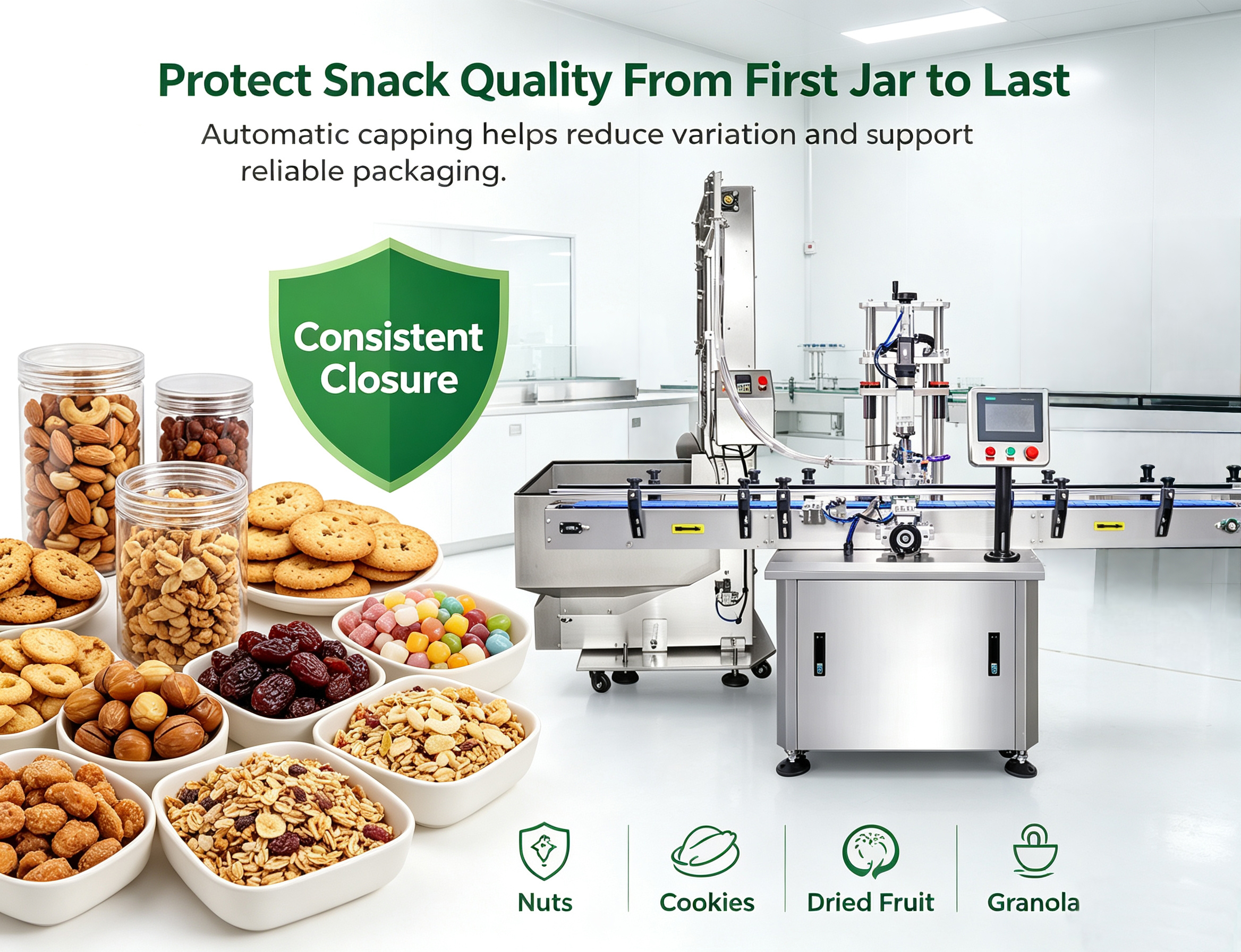
For products such as nuts, cookies, dried fruits, candies, and granola, moisture and air exposure can gradually affect texture, aroma, and taste. This makes the final closure more than a simple packaging step—it is an important part of product protection.
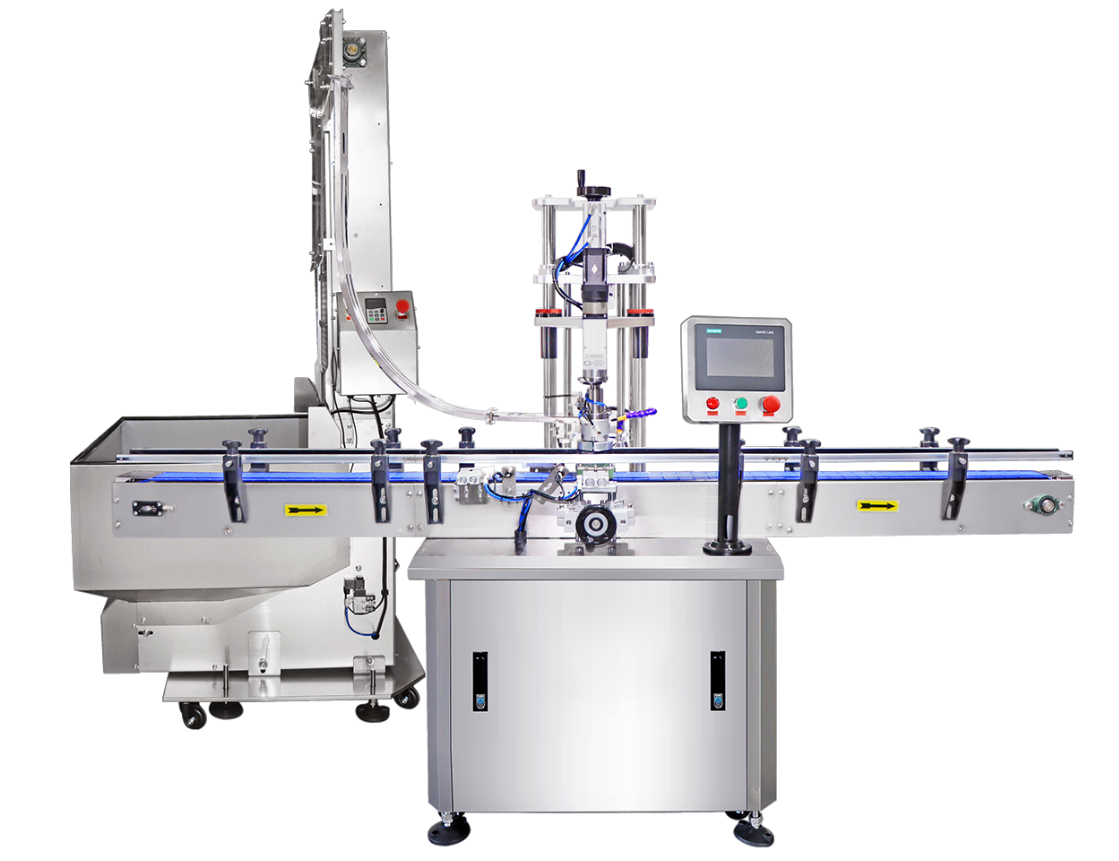
An automatic capping machine provides a controlled way to close containers with consistent positioning and tightening force. For manufacturers using plastic jars, glass jars, and other rigid containers, the right capping system can improve closure consistency while supporting a faster and more reliable packaging process.
Capping Is More Than Putting a Cap on a Jar
In snack packaging, the filling process receives much of the attention, but the final closure is equally important.
A cap that is not tightened consistently may create an unstable package. Excessive tightening, on the other hand, can affect the cap, container threads, or ease of opening.
The objective is therefore not simply to tighten the cap as much as possible. It is to achieve the appropriate and repeatable capping torque for the specific container and cap.
An automatic capping machine helps replace operator-dependent tightening with controlled mechanical operation. This provides a more consistent closure from one container to the next.
The overall protection of the snack still depends on the complete package design, including the container, cap, liner, sealing structure, and storage conditions. However, consistent capping is a fundamental part of reliable package closure.
Controlled Capping Torque Improves Closure Consistency
For screw-cap applications, capping torque is one of the key factors affecting closure performance.
The required torque varies according to the cap diameter, thread design, container material, liner, and overall closure structure. A torque that is too low may result in insufficient tightening, while excessive torque may damage components or make the package difficult to open.
A servo capping machine allows the tightening parameters to be adjusted more precisely according to the packaging requirements.
This is particularly valuable for manufacturers handling different jar sizes or cap specifications, because the capping process can be adapted rather than relying on a fixed manual tightening force.
| Snack Product | Common Packaging | Main Packaging Concern | Suitable Capping Solution |
|---|---|---|---|
| Nuts | Plastic or glass jars | Moisture and air exposure | Automatic screw capping machine |
| Cookies | Plastic jars | Loss of crispness | Automatic jar capping machine |
| Candy | Plastic containers | Loose closure and contamination | Automatic capping machine |
| Dried Fruits | Food-grade jars | Moisture entry | Servo capping machine |
| Granola | Plastic jars | Air and moisture exposure | Automatic screw capper |
| Snack Foods | Plastic or glass containers | Inconsistent sealing | Automatic servo capping machine |
The appropriate machine depends not only on the snack itself, but also on the container, cap structure, required torque, and production conditions.
Automation Brings Consistency to High-Volume Production
Manual capping can work for small-scale production, but maintaining the same tightening result throughout a long production run is more difficult.
Operator differences, fatigue, and variations in working speed can all affect the final closure.
An automatic capping machine standardizes the process. Containers are transported into position, caps are supplied automatically, and the capping head applies the programmed tightening force.
This creates a more repeatable production process and can provide:
- Consistent capping performance
- Adjustable tightening torque
- Automatic cap feeding
- Reduced manual intervention
- Improved packaging efficiency
- More stable continuous production
- Easier integration with other packaging equipment
For snack manufacturers, the advantage is not simply automation for its own sake. It is the ability to turn an operator-dependent process into a controlled packaging operation.
| Feature | Manual Capping | Single Head Capping Machine | Double Head Capping Machine |
|---|---|---|---|
| Capping consistency | Depends on operator | More consistent | More consistent |
| Cap feeding | Manual | Automatic | Automatic |
| Production speed | Limited | 15 – 20 cans/min | 30 – 45 cans/min |
| Labor requirement | Higher | Lower | Lower |
| Production stability | Can vary | More repeatable | More repeatable |
| Packaging line integration | Limited | Easy to integrate | Easy to integrate |
| High-volume snack production | Less suitable | More suitable | More suitable |
| Can height range | 30-250 mm | 30-250 mm | 30-250 mm |
| Can diameter range | 30-120 mm | 30-120 mm | 30-120 mm |
Automatic Cap Feeding Keeps the Process Moving
For continuous production, cap feeding is another important part of the system.
An automatic cap elevator or cap feeding system supplies caps to the capping mechanism without requiring operators to place each cap manually. This reduces manual handling and helps synchronize cap supply with container flow.
A typical automated snack packaging process can be:
Snack Filling → Cap Feeding → Automatic Capping → Labeling → Finished Product Collection
The automatic capper can also be integrated with filling machines, conveyors, labeling machines, inspection systems, and collection equipment.
The result is a complete snack packaging line in which each stage works as part of the same production flow.
One Capping Solution Can Serve Different Snack Applications
Snack manufacturers may use different products and packaging formats within the same facility.
Common applications include:
- Nut jars
- Cookie jars
- Candy containers
- Dried fruit jars
- Granola containers
- Cereal containers
- Snack food jars
- Food supplement containers
- Powder and granular food containers
Plastic and glass jars are common formats, but compatibility must always be confirmed according to the actual container and cap specifications.
Depending on the machine design, adjustable height, capping torque, and change parts can allow the equipment to accommodate different packaging sizes.
This makes machine flexibility an important consideration alongside speed.
Selecting the Right Automatic Capping Machine
A professional capping solution should be selected according to the complete packaging application rather than one specification alone.
Container
Consider the material, diameter, height, shape, and opening size of the jar or bottle.
Cap
Check the cap diameter, thread design, material, and closure structure.
Torque
Determine the required tightening torque according to the actual cap and container combination.
Production Capacity
Match the machine configuration to the required output. Single-head, multi-head, and rotary capping systems can serve different production requirements.
Line Integration
For a complete automated line, the capper should work smoothly with the filling, conveying, labeling, inspection, and collection systems.
In other words, the right choice follows a simple principle:
Product → Container → Cap → Capping Requirements → Production Capacity → Complete Line
Building a More Reliable Snack Packaging Process
A high-quality snack packaging solution is not defined by one machine alone.
The product, packaging material, filling system, capping equipment, labeling equipment, and conveying system must work together.
For example:
Nuts + Plastic Jar + Filling Machine + Automatic Screw Capping Machine + Labeling Machine
creates a complete packaging solution rather than simply a standalone capping operation.
This application-based approach is also important for manufacturers searching online for packaging equipment. Customers are often looking for a specific solution such as:
- Automatic capping machine for nut jars
- Automatic jar capping machine for cookies
- Servo capping machine for glass food jars
- Automatic screw capper for snack packaging
- Complete automatic snack packaging line
These searches connect the product, packaging format, equipment, and production result—the same information that should be clear in a professional packaging equipment solution.
Conclusion
For snack manufacturers, a reliable closure is an important part of protecting the quality of the finished package.
An automatic capping machine provides more than speed. It brings controlled capping torque, consistent closure, automatic cap feeding, reduced manual intervention, and reliable integration with the complete packaging line.
For nuts, cookies, dried fruits, candies, granola, and other snacks, the correct capping solution should be matched to the actual product and packaging requirements.
The goal is not simply to tighten more caps.
It is to create a consistent, reliable, and efficient packaging process that supports product protection from filling to finished package.