
Vacuum Capping Machines in Food Preservation: Key Advantages and Applications
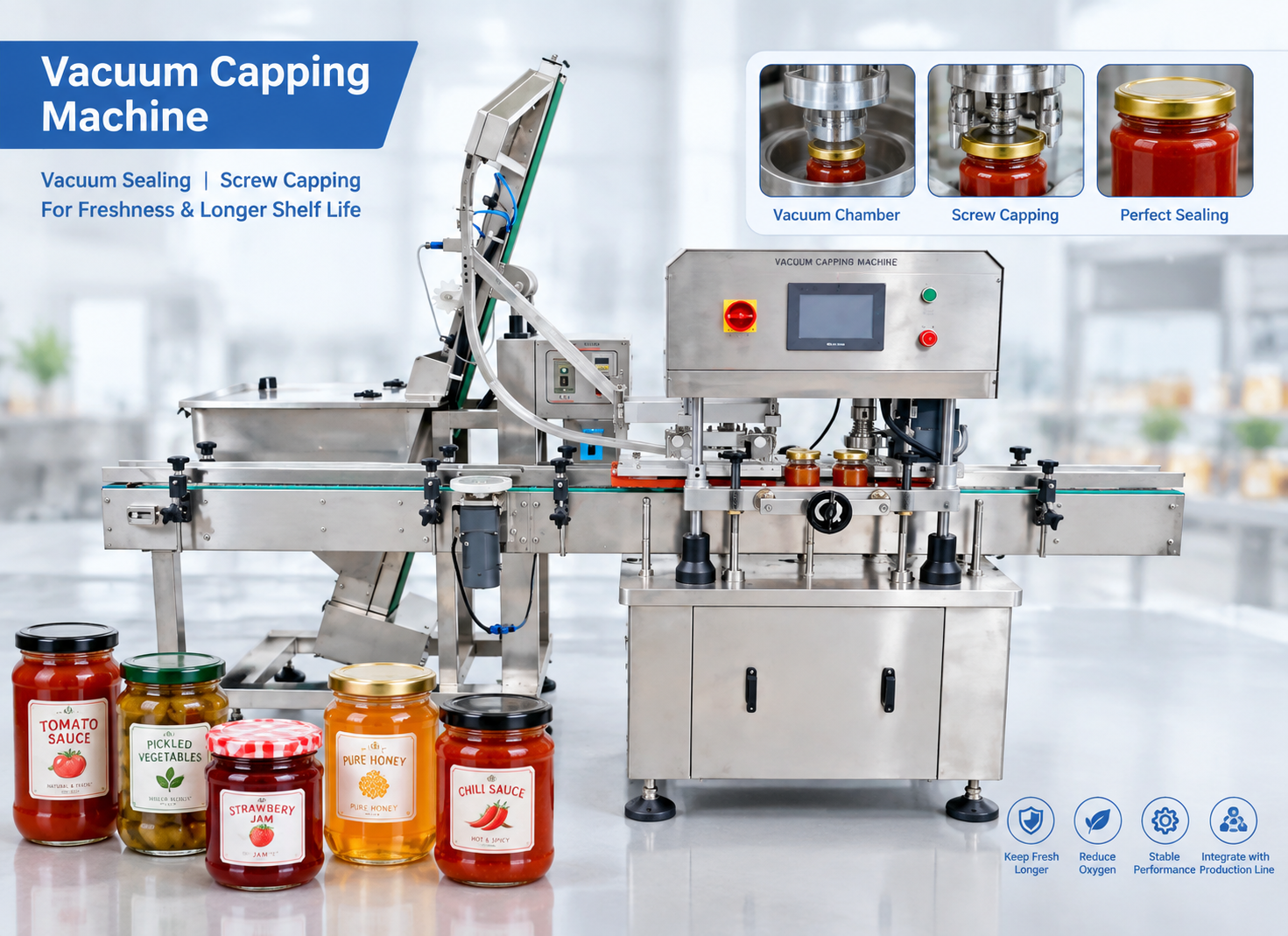
In food packaging, the closure process plays an important role in protecting packaged products. For foods that are sensitive to oxygen exposure, controlling the air inside the container can be an important part of the overall packaging strategy.
Vacuum capping is designed for this type of application, combining vacuum treatment with screw capping to create a controlled closure process. It is commonly used with suitable glass jars and screw-type closures for products such as sauces, jams, pickled foods, honey, spreads, and other processed foods.
This article explains how vacuum capping machines work, their key advantages, common food packaging applications, and how they compare with conventional screw capping equipment.
What Is a Vacuum Capping Machine?
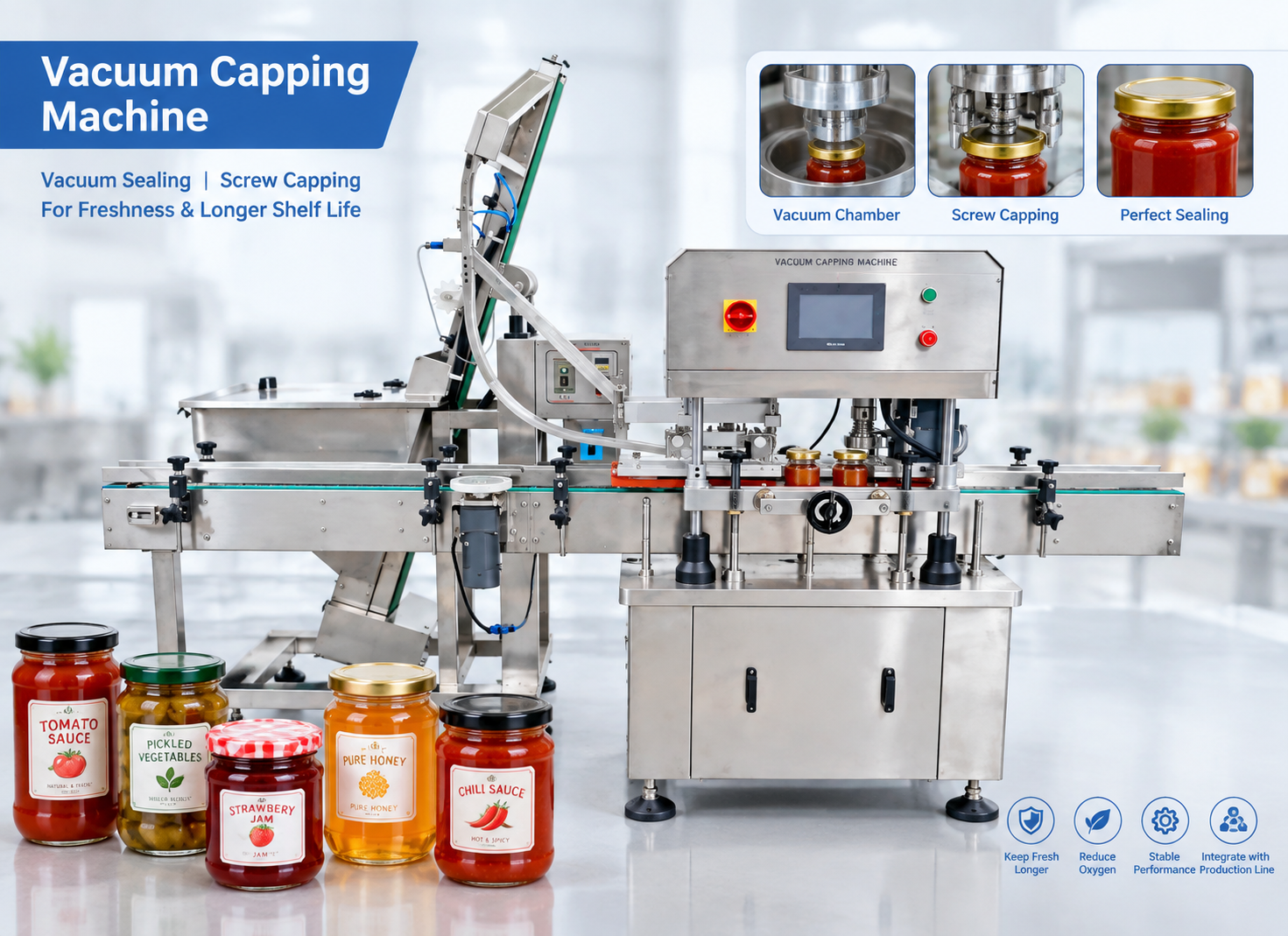
A vacuum capping machine is packaging equipment that combines vacuum extraction with screw capping.
The machine first positions the cap on the container opening. The container is then placed in a locally sealed vacuum chamber, where air is extracted from the headspace. Once the preset vacuum level is reached, the capping mechanism tightens the cap to complete the closure.
The basic process can be summarized as:
Cap Pre-Positioning → Local Vacuum Sealing → Air Extraction → Set Vacuum Reached → Screw Capping → Discharge
This working method distinguishes vacuum capping from a conventional screw capping process, which normally focuses on applying and tightening the cap without first creating a vacuum inside the container.
How Does a Vacuum Capping Machine Work?
- Container Feeding
Filled containers enter the capping station through a conveyor or manual feeding system.
- Cap Placement
The cap is positioned on the container opening. Depending on the line configuration, caps can be supplied manually or automatically through a cap handling system.
- Vacuum Generation
Air is removed from the container headspace to create the required vacuum condition.
- Screw Capping
The cap is tightened under controlled conditions to achieve the required closure performance.
- Product Discharge
After capping, the sealed containers continue to the next packaging stage, such as labeling, inspection, or collection.
This combination of air removal and controlled screw capping makes vacuum capping particularly useful for food packaging applications where headspace control is important.
Key Advantages of Vacuum Capping
Reduced Headspace Oxygen
Vacuum capping can reduce the amount of air remaining inside the container. This can help limit oxygen exposure for products where oxidation is a packaging concern.
Consistent Closure
Automatic vacuum capping equipment can provide controlled capping parameters, helping maintain more consistent closure quality during continuous production.
Better Package Protection
A properly sealed and vacuumed container can provide a controlled internal environment. However, actual product shelf life depends on the product formulation, processing conditions, packaging materials, storage environment, and other factors.
Suitable for Automated Production
Vacuum capping machines can be integrated with filling machines, conveyors, labeling machines, inspection systems, and other packaging equipment.
Vacuum Capping vs. Conventional Screw Capping
Both machines apply screw caps, but their packaging functions are different.
| Machine Comparison | Vacuum Capping Machine | Standard Screw Capping Machine |
| Suitable Container Material | Food-grade glass bottles | Glass, plastic, metal jars |
| Applicable Bottle Diameter | 30mm – 80mm | 30mm – 130mm |
| Applicable Bottle Height | 50mm – 220mm | 30mm – 220mm |
| Vacuum Chamber | Yes | Normally no |
| Screw Capping | Yes | Yes |
| Main Function | Vacuum closure + screw capping | Screw capping |
| Vacuum Degree | -40KPa ~ -70KPa | No vacuum function |
| Power Supply | AC220V 50/60Hz | AC220V 50/60Hz |
| Working Air Pressure | ≥0.5MPa | 0.5 – 0.6MPa |
| Available Capping Heads | Optional 1, 2, 4, 6 capping heads to match production output | Optional 1-head, 2-head configurations |
| Production Line Integration | Yes | Yes |
| Automation Options | Semi-automatic / automatic | Semi-automatic / automatic |
A conventional screw capping machine can be suitable when the main requirement is to apply and tighten the cap.
A vacuum capping machine is designed for applications where air removal and controlled vacuum closure are also part of the packaging requirement.
Therefore, the choice should be based on the product, container, closure system, required packaging conditions, and production process.
Semi-Automatic Vacuum Capping for Small-Batch Production
Not every manufacturer needs a fully automated packaging line from the beginning.
A semi-automatic vacuum capping machine can be suitable for:
- Small-batch food production
- Start-up food companies
- New product development
- Product trials
- Seasonal production
- Small and medium-sized manufacturers
- Production involving frequent container changes
In a semi-automatic process, the operator can position the container and cap, while the machine performs the vacuum and capping operation.
This configuration provides the vacuum capping function with a relatively simple operating process and can be a practical starting point for manufacturers that are not yet ready for a complete automatic line.
As production increases, additional equipment such as automatic container feeding, cap handling, conveyors, filling machines, and labeling machines can be integrated into the system.
| Feature | Semi-Automatic Vacuum Capping Machine | Fully Automatic Vacuum Capping Machine |
| Operation Method | Operator manually places containers and/or caps, while the machine performs vacuum capping | Containers and caps are automatically transferred and processed |
| Production Capacity | Suitable for small to medium production | Suitable for continuous high-volume production |
| Initial Investment | Lower equipment investment | Higher investment due to automation systems |
| Production Flexibility | Easy to switch between different container sizes and products | Better for stable production with standardized containers |
| Suitable Applications | Start-ups, small-batch production, product trials, seasonal products | Large-scale food production, automated packaging lines |
| Space Requirement | More compact and suitable for limited production areas | Requires more production space depending on line configuration |
| Best Choice For | Manufacturers prioritizing flexibility and lower investment | Manufacturers requiring higher efficiency and continuous operation |
How to Choose a Vacuum Capping Machine
Selecting a vacuum capping machine requires more than looking at production speed. Several factors should be considered.
Container Specifications
Container diameter, height, material, neck design, and opening dimensions can affect machine configuration.
Cap Specifications
Cap diameter, thread design, material, sealing liner, and closure structure should be compatible with the capping system.
Vacuum Requirements
The required vacuum level depends on the product and packaging design. It should be established according to actual product and container testing rather than using one setting for every application.
Production Capacity
The required containers per minute should be considered together with the complete vacuum and capping cycle. Different machine configurations can be selected according to production requirements.
Automation Level
Semi-automatic equipment may be suitable for small-batch and flexible production, while automatic systems are more appropriate for continuous production and higher-volume packaging.
Future Line Expansion
If production is expected to grow, it is useful to consider whether the machine can be integrated with upstream and downstream packaging equipment.
Vacuum Capping in a Complete Packaging Line
A vacuum capping machine can be used as an individual unit or integrated into a complete packaging system.
A typical food packaging line may include:
Container Unscrambler → Air Cleaning → Filling Machine → Vacuum Capping Machine → Labeling Machine → Inspection → Collection
The filling equipment can be selected according to the characteristics of the product. For example, different applications may use piston fillers, gear pump fillers, magnetic pump fillers, weighing filling systems, or other customized filling technologies.
The vacuum capping machine can then be connected with the conveyor and downstream equipment to create a continuous packaging process.
For manufacturers with different production capacities, the capping system can also be configured with different numbers of capping heads according to the required output and container specifications.
Vacuum Capping Machine Manufacturer
As a packaging equipment source manufacturer, we provide vacuum capping solutions for different food packaging applications and production requirements.
Our vacuum capping equipment can be supplied as individual machines or integrated with filling, conveying, labeling, inspection, and other packaging equipment to create complete packaging lines.
Machine configuration can be selected according to the container, cap, product characteristics, vacuum requirements, production capacity, and required automation level.
This allows manufacturers to develop a packaging solution around their actual production process rather than selecting a standard machine without considering the complete line.
FAQ
What is a vacuum capping machine?
A vacuum capping machine removes air from a container inside a locally sealed vacuum chamber and then tightens the screw cap after the preset vacuum level is reached.
What is the difference between vacuum capping and normal screw capping?
A conventional screw capping machine mainly applies and tightens the cap. A vacuum capping machine additionally removes air from the container headspace before completing the capping process.
Is a semi-automatic vacuum capping machine suitable for small businesses?
Yes. It can be suitable for start-ups, small-batch production, product trials, and manufacturers that need flexible production.
What food products can be vacuum capped?
Common applications include sauces, jams, pickled foods, honey, syrups, spreads, nuts, snacks, and other products packaged in compatible screw-cap containers.
Can a vacuum capping machine be connected to a filling machine?
Yes. It can be integrated with filling machines, conveyors, labeling machines, inspection systems, and other equipment to build a complete packaging line.
How should I choose a vacuum capping machine?
The main factors include the container and cap specifications, required vacuum level, production capacity, automation level, and compatibility with the complete packaging line.
Conclusion
A vacuum capping machine combines controlled air extraction with screw capping. Its key feature is the ability to remove air inside a locally sealed vacuum chamber and complete the capping process after the preset vacuum level is reached.
For food manufacturers, this technology can provide controlled vacuum closure for suitable products and containers, while offering flexible automation options for both small-batch and continuous production.
Whether used as a standalone machine or integrated into a complete filling, vacuum capping, labeling, and inspection line, the right configuration should be selected according to the product, container, cap, vacuum requirements, production capacity, and overall packaging process.