
Servo Piston Filling Machine: Precision Filling Solutions for Peanut Butter, Sauces, Oils and More
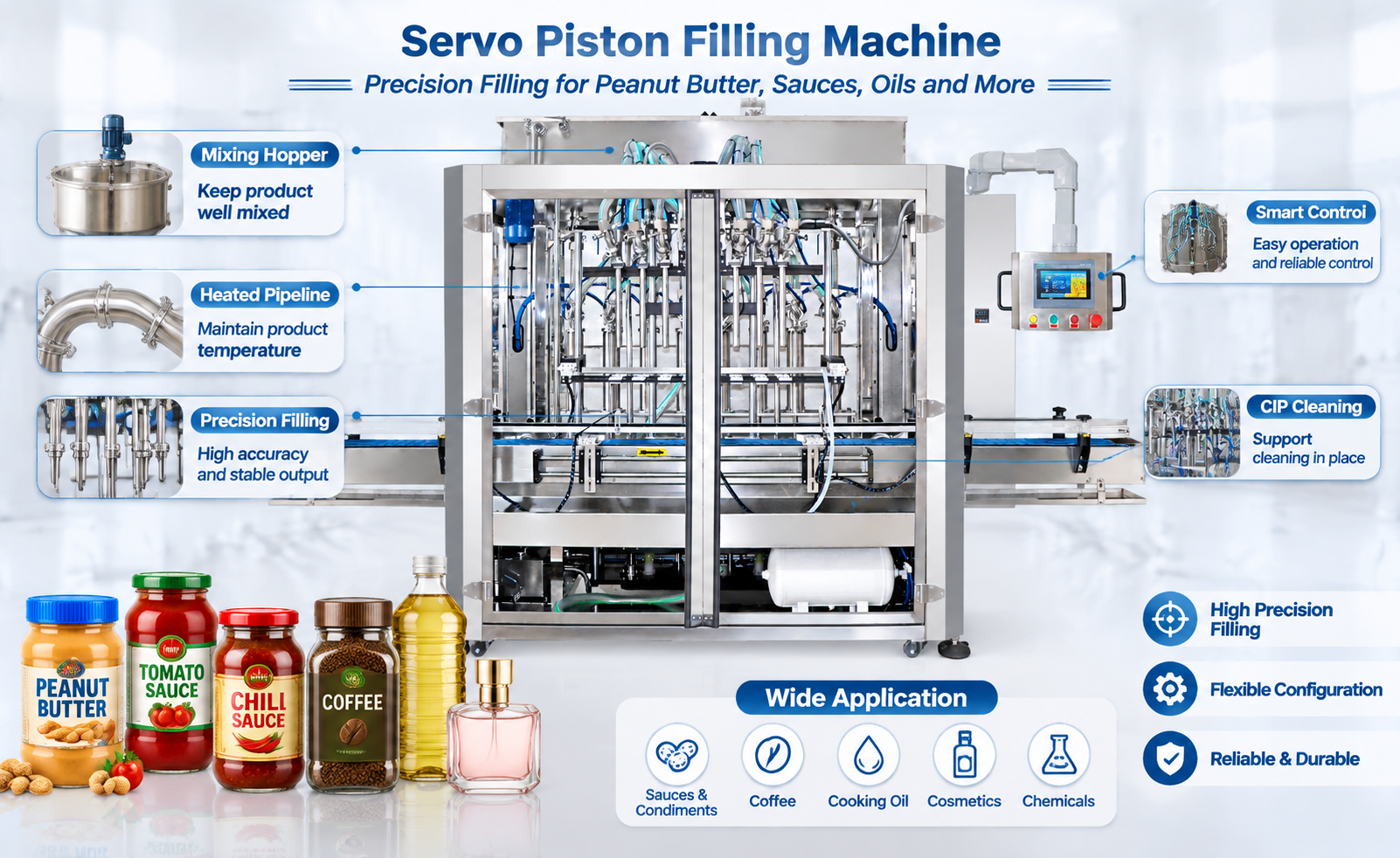
In food, beverage, cosmetic, and chemical packaging industries, choosing the right filling equipment is essential for maintaining product consistency, filling accuracy, and production efficiency. For manufacturers handling products with different viscosities, a servo piston filling machine offers a flexible and reliable filling solution.
Unlike traditional filling systems that rely on simple pneumatic movements, a servo-driven piston filler uses a servo motor to control piston displacement, allowing more precise adjustment of the filling volume and operating speed.
From thick peanut butter and tomato sauce to cooking oil, coffee products, shampoo, and perfume, this type of filling equipment can be configured to accommodate different product characteristics and production requirements.
This guide explains how a servo piston filling machine works, which products it can handle, what optional configurations are available, and what buyers should consider before selecting a machine.
1. What Is a Servo Piston Filling Machine?
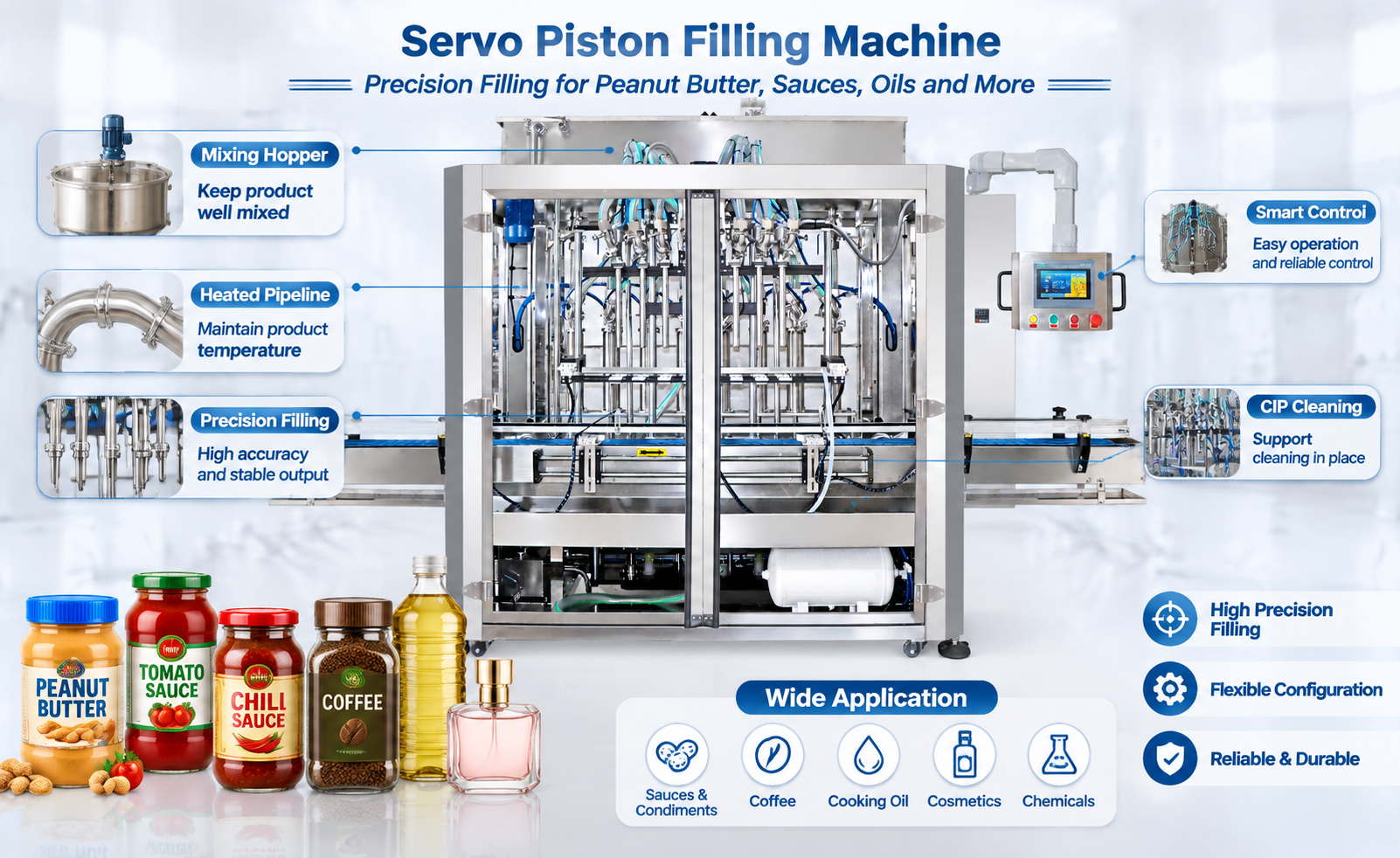
A servo piston filling machine is an automatic or semi-automatic filling system that uses a piston and cylinder assembly to draw product from a hopper and dispense a predetermined volume into containers.
The servo motor controls the piston movement through a mechanical transmission system. By adjusting the piston travel distance and movement speed, the machine controls the amount of product dispensed during each filling cycle.
Compared with conventional pneumatic piston fillers, servo-driven systems provide more flexible control over filling volume, acceleration, deceleration, and filling speed.
This makes them particularly suitable for manufacturers that require consistent filling performance across different products and container sizes.
Typical applications include:
Food products: Peanut butter, tomato sauce, chili sauce, sweet chili sauce, cooking oil, and other condiments.
Beverage and coffee products: Coffee concentrates, coffee liquids, and other suitable liquid products.
Cosmetics: Perfume, lotions, creams, shampoo, and other cosmetic formulations.
Chemical products: Detergents, liquid additives, and other compatible materials.
The actual filling configuration should be selected according to product viscosity, flow characteristics, temperature requirements, and container specifications.
2. How Does a Servo Piston Filling Machine Work?
The working principle is based on the reciprocating movement of a piston inside a cylinder. The piston draws product into the cylinder during the suction stage and pushes it through the filling nozzle during the dispensing stage.
The servo motor controls the piston position, while the pneumatic control system operates the relevant valves and filling nozzle mechanisms.
Main Working Process
| Stage | Operation | Description |
|---|---|---|
| 1. Product Supply | Product enters the hopper | The material is supplied to the filling system from the storage hopper |
| 2. Suction | Piston moves backward | The piston draws a predetermined amount of product into the cylinder |
| 3. Container Positioning | Bottles enter the filling station | Photoelectric sensors detect and count incoming containers |
| 4. Filling Head Positioning | Filling nozzles descend | The filling heads move to the preset filling position |
| 5. Product Dispensing | Piston moves forward | The servo motor controls piston displacement to dispense the required volume |
| 6. Nozzle Return | Filling heads rise | The nozzles return to the standby position after filling |
| 7. Container Discharge | Filled containers move out | The conveyor transfers filled containers to the next packaging process |
The machine can also be configured with different conveyor operating modes:
Continuous Conveyor Mode: The conveyor keeps running during the filling process. This is suitable for production lines designed for continuous container movement.
Intermittent Conveyor Mode: The conveyor pauses during filling and resumes after the filling operation is completed. This helps maintain stable container positioning during dispensing.
3. Why Choose a Servo-Driven Piston Filling System?
For manufacturers handling products with different viscosities, servo control offers several practical advantages.
| Key Advantage | Description | Benefit to Buyers |
|---|---|---|
| Precise Volume Control | Servo motor controls piston displacement | Supports consistent filling volumes |
| Adjustable Filling Speed | Filling speed can be adjusted through control parameters | Accommodates different material flow characteristics |
| Flexible Volume Settings | Filling volume can be adjusted according to production requirements | Makes product changeovers more convenient |
| Stable Operation | Coordinated servo and pneumatic control systems manage the filling cycle | Supports reliable production |
| Multiple Filling Configurations | Different filling heads and material supply systems are available | Adapts to different production capacities |
For thick products such as peanut butter and concentrated sauces, filling speed and nozzle design are particularly important. A suitable filling configuration helps reduce material splashing, dripping, and inconsistent dispensing.
4. What Products Can a Servo Piston Filling Machine Handle?
One of the main advantages of a servo piston filler is its adaptability to different liquid and semi-liquid products.
However, different materials require different feeding and filling configurations.
Food Products
Peanut Butter
Peanut butter is a typical high-viscosity material. It has a thick consistency and may contain suspended particles, depending on the formulation.
For peanut butter filling applications, the machine can be equipped with:
A large-capacity material hopper.
A hopper with an agitator to maintain material consistency.
Heated material storage and insulated pipelines when temperature control is required.
Heated filling nozzles to help maintain suitable material flow.
A detachable cylinder assembly for easier cleaning.
A CIP-compatible material supply and cleaning configuration, where applicable.
These options help improve material handling and reduce the difficulties associated with filling thick products.
Sauces and Condiments
Servo piston filling machines can also handle various sauces, including:
Tomato sauce
Sweet chili sauce
Chili sauce
Green pepper sauce
Peanut sauce
Other viscous food sauces
For products with different flow characteristics, the hopper, pipeline diameter, filling nozzle, and filling speed can be selected accordingly.
Coffee and Beverage Products
Depending on the formulation and viscosity, servo piston fillers can be used for suitable coffee liquids, coffee concentrates, and other beverage products.
For relatively low-viscosity materials, the filling system can be configured with suitable nozzles and product-contact components to support smooth dispensing.
Cosmetic Products
In cosmetic production, servo piston filling equipment can be used for products such as:
Perfume
Lotion
Cream
Shampoo
Cosmetic liquids
For these applications, filling volume consistency, product compatibility, and hygienic material-contact components are important selection considerations.
Edible Oils
Cooking oil and other edible oils can also be filled using piston-based systems. However, for certain low-viscosity oils and high-output applications, other filling technologies may also be worth comparing.
The best choice depends on the required filling volume, accuracy, product characteristics, and production capacity.
5. Optional Configurations for Different Filling Requirements
Different products require different material handling solutions. For manufacturers filling peanut butter, thick sauces, and temperature-sensitive products, optional configurations can significantly improve the overall filling process.
| Optional Configuration | Main Function | Suitable Applications |
|---|---|---|
| Material Hopper | Stores and supplies product to the filling system | Sauces, oils, creams, and other liquids |
| Hopper with Agitator | Keeps the material moving and helps maintain consistency | Peanut butter, sauces, and products with suspended ingredients |
| Heated Hopper | Maintains the required product temperature | Temperature-sensitive viscous products |
| Heated Pipeline | Helps prevent material from cooling and becoming too thick during transfer | Peanut butter, chocolate-based products, and thick sauces |
| Heated Filling Nozzles | Maintains suitable material flow near the dispensing outlet | High-viscosity and temperature-sensitive materials |
| CIP Cleaning Configuration | Allows cleaning through a compatible cleaning-in-place system | Food and cosmetic production lines |
| Detachable Cylinder Assembly | Allows the cylinder components to be removed for manual cleaning and maintenance | Products requiring frequent cleaning or material changes |
Why Are Heating and Agitation Important for Peanut Butter Filling?
Peanut butter has a relatively high viscosity, and its flow characteristics can change with temperature.
If the material becomes too thick during production, it may affect suction, dispensing speed, and filling consistency.
A heated hopper, agitator, insulated pipeline, and heated filling nozzles can help maintain more stable material conditions throughout the filling process.
The heating temperature should be determined according to the product formulation and processing requirements rather than using one fixed temperature for all materials.
CIP Cleaning and Detachable Cylinder Design
Cleaning is another important consideration when selecting filling equipment for food and cosmetic applications.
A CIP-compatible configuration can circulate an appropriate cleaning solution through designated product-contact passages without requiring complete equipment disassembly.
For products that require more thorough manual cleaning or frequent product changeovers, a detachable cylinder assembly provides another cleaning option.
6. What Should Buyers Consider Before Choosing a Servo Piston Filler?
Selecting a filling machine based only on the product name is not enough. Several technical factors should be evaluated before purchasing.
| Selection Factor | What Buyers Should Confirm | Why It Matters |
|---|---|---|
| Product Viscosity | Is the product thin, medium-viscosity, or highly viscous? | Determines the piston, pump, and nozzle configuration |
| Filling Volume | What is the required volume per container? | Determines the cylinder size and filling range |
| Product Temperature | Does the product require heating or temperature maintenance? | Helps determine whether heated hoppers, pipes, or nozzles are needed |
| Container Type | Glass bottles, plastic bottles, jars, or other containers? | Affects filling head positioning and conveyor design |
| Production Capacity | How many containers are required per minute? | Determines the number of filling heads and machine configuration |
| Cleaning Requirements | Is manual cleaning sufficient, or is CIP required? | Determines the product-contact structure and cleaning system |
| Product Characteristics | Does the material contain particles, air bubbles, or suspended ingredients? | Affects filling stability and nozzle selection |
7. Common Problems and Troubleshooting
Proper operation and routine maintenance help maintain filling accuracy and production stability.
The following table summarizes several common problems that operators may encounter.
| Problem | Possible Causes | Recommended Solutions |
|---|---|---|
| Pneumatic Cylinder Does Not Operate | Unstable air supply, faulty solenoid valve, loose wiring, or blocked valve core. | Check the air supply, inspect electrical connections, clean or replace the valve if necessary. |
| Conveyor Does Not Run | Incorrect inverter parameters, inverter alarm, or loose motor wiring. | Check the inverter settings, reset alarms according to the manual, and inspect electrical connections. |
| Machine Does Not Power On | Main circuit breaker is off, external power supply is unstable, or a short circuit has occurred. | Check the power supply, circuit breaker, and electrical system. |
| Machine Does Not Dispense Product | Insufficient air pressure, blocked pneumatic lines, servo alarm, or incorrect servo parameters. | Check the air supply, pneumatic circuit, PLC output, servo drive, and mechanical transmission. |
| Inaccurate Filling Volume | Inconsistent material supply, air bubbles, incorrect settings, worn components, or poor valve sealing. | Check the material condition, servo parameters, cylinder sealing, and filling valve connections. |
Recommended Maintenance Checks
To reduce unexpected downtime, operators should regularly inspect:
Air Supply: Maintain a stable compressed air supply. The pneumatic system should be operated within the machine manufacturer's specified pressure range. The reference configuration uses approximately 0.6–0.8 MPa, with certain functions requiring 0.7–0.8 MPa.
Servo System: Check the servo drive for alarms and inspect motor and encoder connections.
Piston and Cylinder: Check the transmission mechanism for abnormal resistance, damage, or insufficient lubrication.
Filling Valves: Inspect the filling nozzles, valve connections, and sealing performance.
Product Supply: Ensure the hopper contains sufficient material and that the product is free from excessive air bubbles or inconsistent density.
Electrical Components: Keep solenoid valve terminals and electrical connections dry and secure.
If a servo alarm, abnormal mechanical noise, or repeated filling error occurs, stop the machine and follow the manufacturer's maintenance instructions. Do not continue production until the cause has been identified.
8. Why Work with an Experienced Filling Machine Manufacturer?
Choosing a filling machine manufacturer involves more than comparing machine prices and filling speeds. The supplier should understand the characteristics of the product and be able to recommend a suitable configuration.
For peanut butter, thick sauces, coffee, edible oils, and cosmetic products, the filling system may require different combinations of piston cylinders, material hoppers, agitators, heating systems, pipelines, and filling nozzles.
An experienced manufacturer can help evaluate these requirements and provide a suitable filling solution based on:
Product viscosity and filling characteristics.
Required filling volume and production capacity.
Container dimensions and packaging materials.
Heating, agitation, and cleaning requirements.
Integration with capping, labeling, and other packaging equipment.
At Guangzhou Full Harvest Industries Co.,Ltd, we provide filling and packaging equipment solutions for different industries and product applications. Our servo piston filling machines can be configured according to specific material characteristics and production requirements, helping manufacturers build efficient and practical filling systems.
Conclusion
A servo piston filling machine is a versatile filling solution for manufacturers handling liquid, semi-liquid, and viscous products. Its servo-controlled piston system provides adjustable filling volume and speed, while optional configurations such as agitator-equipped hoppers, heated pipelines, heated filling nozzles, CIP-compatible systems, and detachable cylinders help accommodate more demanding applications.
Whether filling peanut butter, tomato sauce, chili sauce, coffee products, cooking oil, or cosmetic liquids, the right machine configuration should be determined by the product's viscosity, temperature, filling volume, and cleaning requirements.
Looking for a servo piston filling machine for your product? Contact Guangzhou Full Harvest Industries Co.,Ltd with your product details, filling volume, and container specifications to discuss a suitable filling solution.