
Screw Capping Machine vs Dust Cover Capping Machine vs ROPP Capping Machine: Which One Fits Your Production Line?
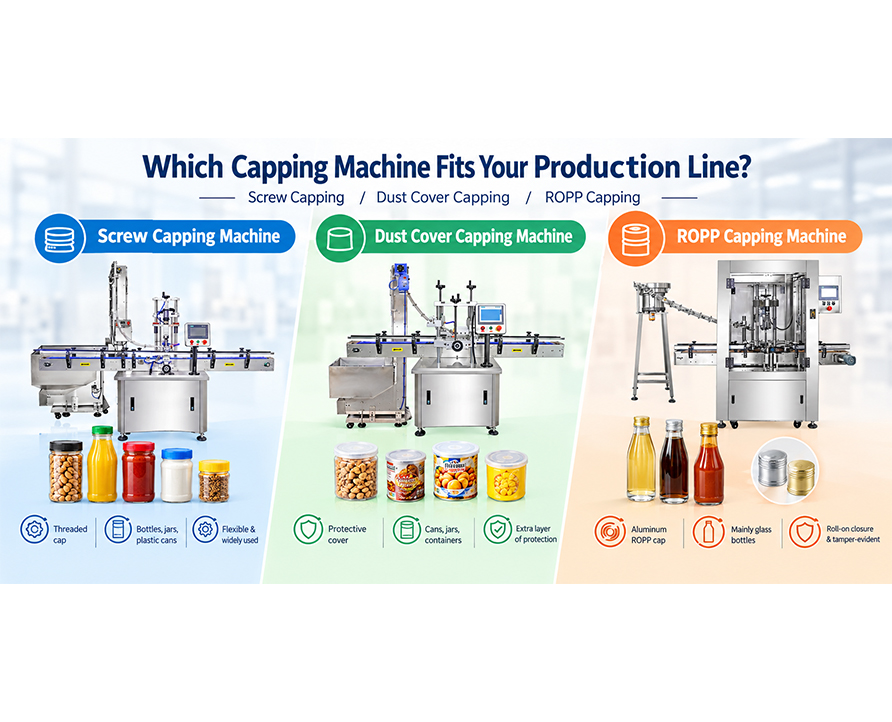
Choosing a capping machine depends on more than production speed. The cap design, container type, product characteristics, closure requirements, and overall packaging line all influence which capping technology is suitable.
This article compares three common capping solutions — screw capping, dust cover capping, and ROPP capping.
Understanding how each machine works and where it fits in a packaging line can make equipment selection much easier — and help you choose the right solution for your container, closure, and production line.
1. Screw Capping Machine
A screw capping machine is designed to automatically place and tighten threaded caps onto bottles, jars, and other suitable containers.
During operation, caps are supplied to the capping station, positioned on the container, and tightened by the capping head. Servo-controlled models can provide adjustable capping parameters for more consistent closing performance.
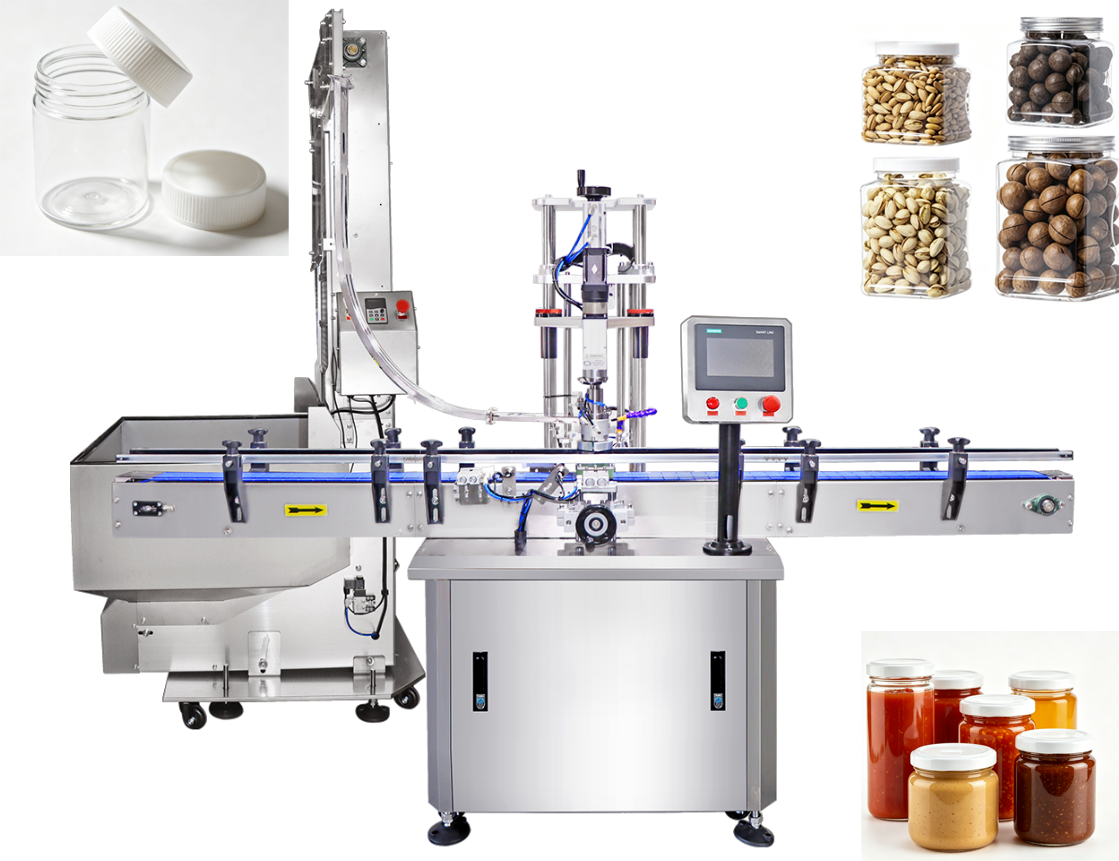
Screw capping machines are widely used for:
- Sauces and condiments
- Juice and beverages
- Nuts and snacks
- Food ingredients
- Household chemicals and personal care products
- Other products using threaded plastic caps
Depending on the container and cap design, the machine can be configured as a single-head, double-head, linear, or other automatic capping system.
It can also be connected with upstream and downstream equipment such as a bottle unscrambler, filling machine, cap elevator, induction foil sealer, labeling machine, date coder, and collection conveyor.
Why choose a screw capping machine?
A screw capping machine handles a wide range of threaded closures on both plastic and glass containers. Servo-controlled models allow torque and speed to be adjusted according to the cap and container, ensuring consistent tightening without over-tightening or damaging the closure. The machine can be configured as single-head, double-head, linear, or rotary, and integrated with upstream and downstream equipment to form a complete automatic packaging line.
2. Dust Cover Capping Machine
A dust cover capping machine is used when the package requires a protective dust cover or similar outer cover.
Instead of simply tightening a threaded cap, the machine focuses on accurately feeding, positioning, and pressing the protective cover onto the container.
This type of equipment can be particularly useful for food and dry products where an additional protective layer is required around the container opening.
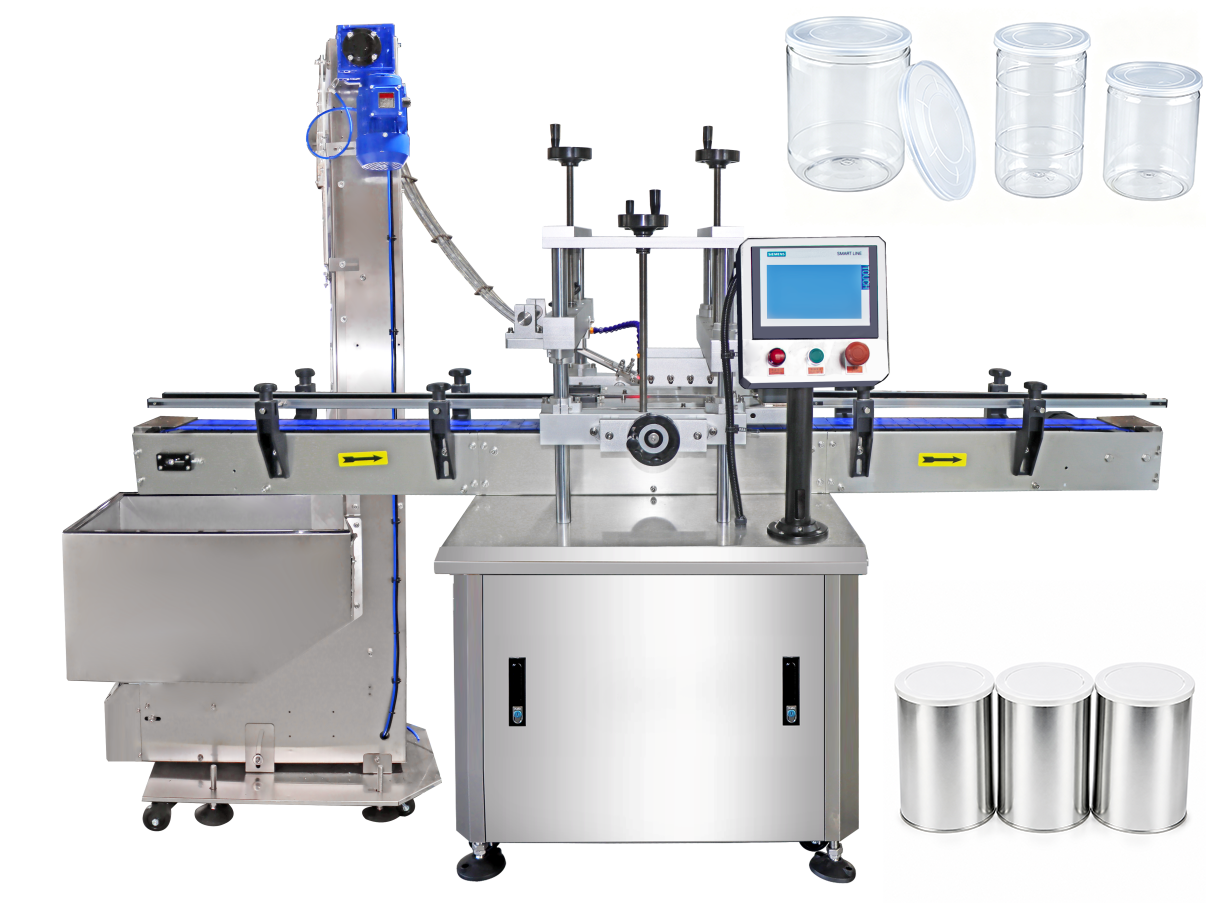
Typical applications include:
- Snacks
- Nuts and seeds
- Powdered food
- Seasonings
- Food ingredients
- Selected chemical products
A dust cover pressing process can be incorporated into an automatic packaging system after filling and sealing.
For example:
Filling → Can Sealing → Dust Cover Feeding → Dust Cover Pressing → Labeling → Collection
The exact configuration depends on the container structure and the type of dust cover being used.
Why choose a dust cover capping machine?
When a separate dust cover is required, manual placement often results in inconsistent positioning and seating depth. A dedicated dust cover capping machine automates cover feeding, positioning, and pressing, ensuring each cover is placed consistently before labeling and collection. This reduces manual handling and improves package consistency.
3. ROPP Capping Machine
A ROPP capping machine, or Roll-On Pilfer-Proof capping machine, is designed for aluminum ROPP caps.
Unlike a conventional screw capper, the ROPP machine uses rollers to form the aluminum cap around the bottle neck during the capping process.
The rollers shape the cap according to the bottle-neck profile, creating the finished closure.
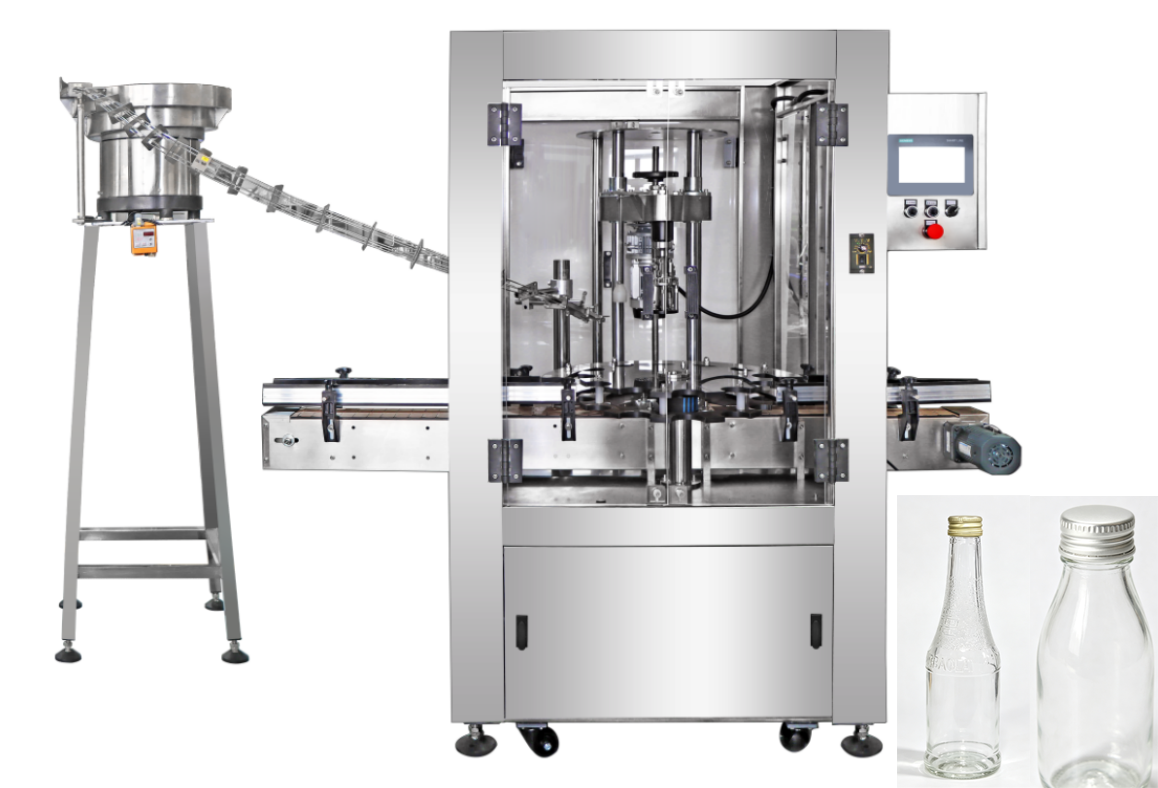
ROPP capping is commonly used for:
- Beverages
- Sauces and condiments
- Food products
- Pharmaceutical products
- Chemical products
- Other products using aluminum ROPP closures
The compatibility between the bottle neck, aluminum cap, thread profile, and capping tooling is particularly important when selecting this type of equipment.
Depending on production requirements, a ROPP capping machine can be configured as a single-head or multi-head system. It can also be integrated with upstream and downstream equipment such as filling machines, induction foil sealers, labeling machines, and date coders to form a complete automatic packaging line.
Why choose a ROPP capping machine?
ROPP technology is appropriate when the final package requires an aluminum roll-on closure rather than a conventional plastic screw cap.
Screw Capping vs Dust Cover Capping vs ROPP Capping
Although all three machines perform a closing operation, their working principles and application scenarios are different.
| Feature | Screw Capping Machine | Dust Cover Capping Machine | ROPP Capping Machine |
|---|---|---|---|
| Main closure | Threaded screw cap | Protective dust cover | Aluminum ROPP cap |
| Working principle | Tightens cap onto container | Positions and presses cover | Rolls/forms aluminum cap |
| Typical cap material | Plastic | Plastic or protective cover | Aluminum |
| Typical containers | Bottles, jars, plastic cans | Selected cans, jars and containers | Mainly compatible glass bottles |
| Main advantage | Flexible threaded-cap application | Additional package protection | Aluminum roll-on closure |
| Torque control | Available on servo models | Pressing adjustment | Roller/forming adjustment |
| Tamper-evident option | Depends on cap design | Depends on package design | Common with suitable ROPP closure |
| Application flexibility | High | Depends on cover design | Depends on bottle-neck design |
| Machine configuration | Single-head, double-head, linear or rotary | Linear or rotary | Single-head or multi-head |
| Common products | Food, beverages, sauces, chemicals | Snacks, powders, food products | Beverages, sauces, food, pharmaceutical products |
Which Capping Machine Fits Your Production Line?
The best choice starts with the closure, not the machine model.
Choose a Screw Capping Machine When:
Your container uses a threaded plastic cap.
You need adjustable torque control for consistent tightening.
You are packaging sauces, beverages, snacks, food products, or similar products.
You need to integrate capping with filling and labeling equipment.
Choose a Dust Cover Capping Machine When:
Your package requires a separate protective dust cover.
The cover needs automatic positioning and pressing.
Your products are mainly packaged in cans, jars, or similar containers.
Choose a ROPP Capping Machine When:
Your container uses aluminum ROPP caps.
The container has a suitable neck finish for ROPP closure.
You need a roll-on aluminum closure.
Tamper-evident closure is required for the package.
What Else Should You Consider Before Buying?
Selecting the capping technology is only the first step. The actual machine configuration should also match the production requirements.
Container Size and Shape
Check the container's:
- Diameter
- Height
- Neck diameter
- Neck finish
- Shape
- Material
- Lid material
Round bottles and jars are generally easier to handle automatically, while irregular containers may require customized positioning or gripping systems.
Cap or Cover Specifications
Cap diameter, height, material, thread design, and feeding method can all affect machine configuration.
For ROPP applications, the aluminum cap and bottle-neck specifications are especially important because the rollers must form the closure correctly.
Production Capacity
The capping machine should be matched to the required line speed.
For example, if a filling machine operates at a significantly higher output than the capping machine, the capper may become a production bottleneck.
Therefore, production capacity should be evaluated across the entire packaging line rather than looking at the capping machine alone.
Product Characteristics
Different products may require different upstream or downstream processes.
For example, a sauce line may require filling, vacuum capping, induction foil sealing, and labeling, while a snack product may use a weighing filler, can sealer, dust cover pressing machine, and labeling system.
Capping Machines Can Be Integrated Into Complete Packaging Lines
Capping equipment can be combined with other packaging machines to build a complete automated solution.
A typical bottle packaging line may include:
Bottle Unscrambler → Filling Machine → Cap Feeding → Capping Machine → Induction Foil Sealer → Labeling Machine → Date Coding → Collection
A food or snack packaging line may instead use:
Feeding → Weighing/Filling → Can Sealing → Dust Cover Pressing → Labeling → Product Collection
Depending on the capping technology selected — screw capping, dust cover capping, or ROPP capping — the capping machine can be positioned at different stages of the line. Screw capping and ROPP capping are typically placed after filling and before induction sealing or labeling. Dust cover capping is usually integrated after can sealing as an additional protection step.
Other processes, such as air cleaning, nitrogen flushing, vacuum treatment, foil sealing, coding, and conveying, can also be incorporated according to product and packaging requirements.
Conclusion
Screw capping machines, dust cover capping machines, and ROPP capping machines solve different packaging requirements.
The key is to match the closure type, container design, product characteristics, and production capacity with the appropriate capping technology.
For manufacturers planning a complete automated packaging line, the capping machine can also be integrated with filling, sealing, labeling, foil sealing, coding, conveying, and other equipment.
By evaluating the entire packaging process rather than the capping machine alone, manufacturers can build a more suitable and scalable production solution.
Frequently Asked Questions
1. What is the main difference between a screw capping machine and a ROPP capping machine?
A screw capping machine tightens pre-threaded caps, while a ROPP capping machine uses rollers to form aluminum caps around the bottle neck. ROPP is typically used for aluminum closures and tamper-evident packaging, while screw capping is a general solution for plastic threaded caps.
2. What is a dust cover capping machine used for?
It automatically positions and presses a protective dust cover onto suitable cans or jars, adding an extra layer of protection to the package.
3. How to choose the right capping machine?
Start with the cap or cover type, then consider the container size, shape, product, and required production speed.
4. Can a capping machine be connected to other packaging machines?
Yes. It can be integrated with filling machines, sealing machines, labeling machines, induction foil sealers, coding machines, and conveyors to create a complete packaging line.
5. Can the capping machine be customized for my containers?
Yes. The capping head and molds are made to match your specific container and cap. Change parts are produced according to the actual container dimensions, cap size, and closure type, ensuring a proper fit and consistent capping performance.