
Linear Capping Machine vs. Rotary Capping Machine: How to Choose the Right Solution for Different Production Needs?
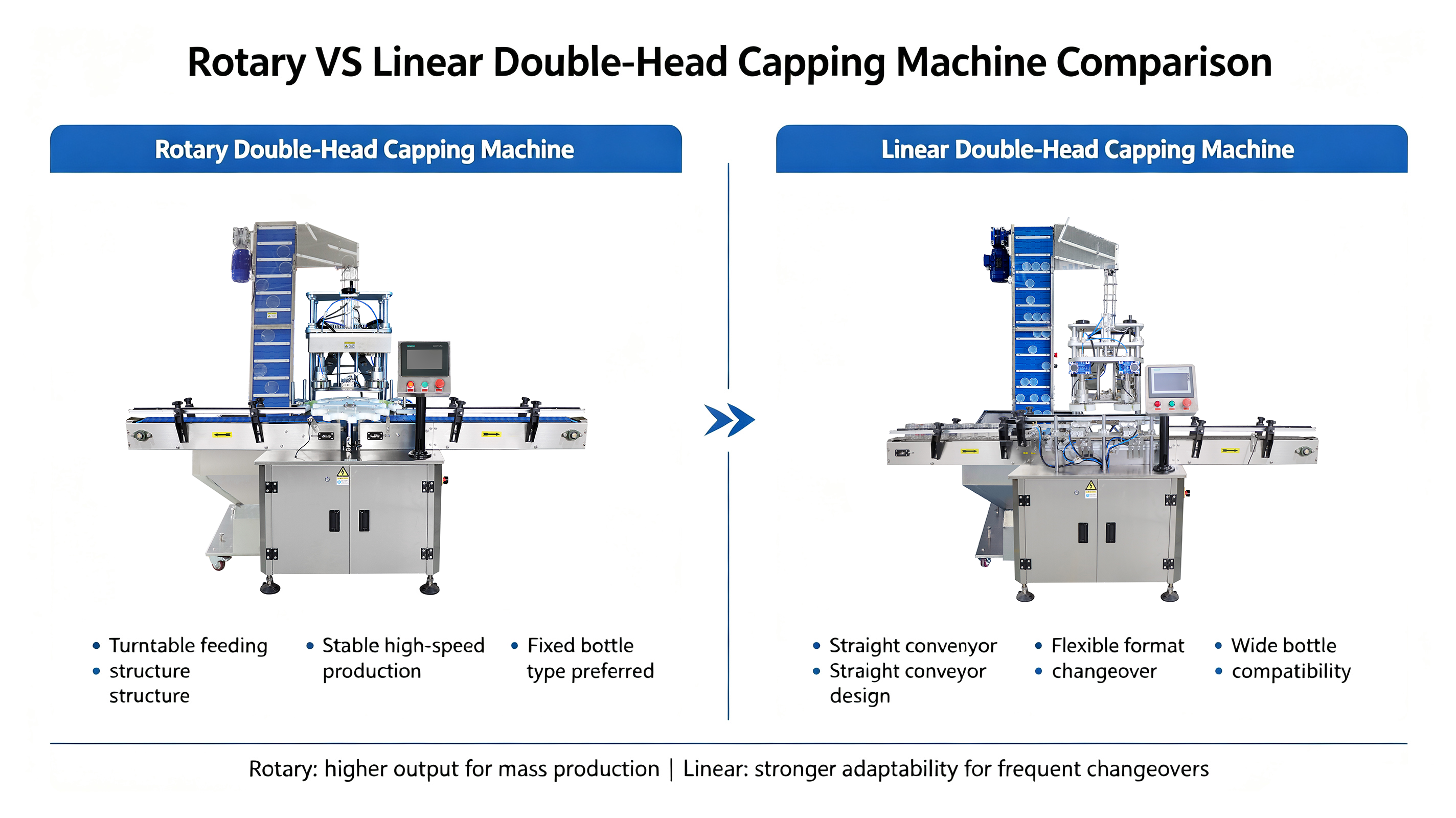
Choosing the right automatic capping machine is an important decision for any packaging line. The capping system directly affects production speed, cap tightening consistency, bottle stability, and the overall efficiency of the packaging process.
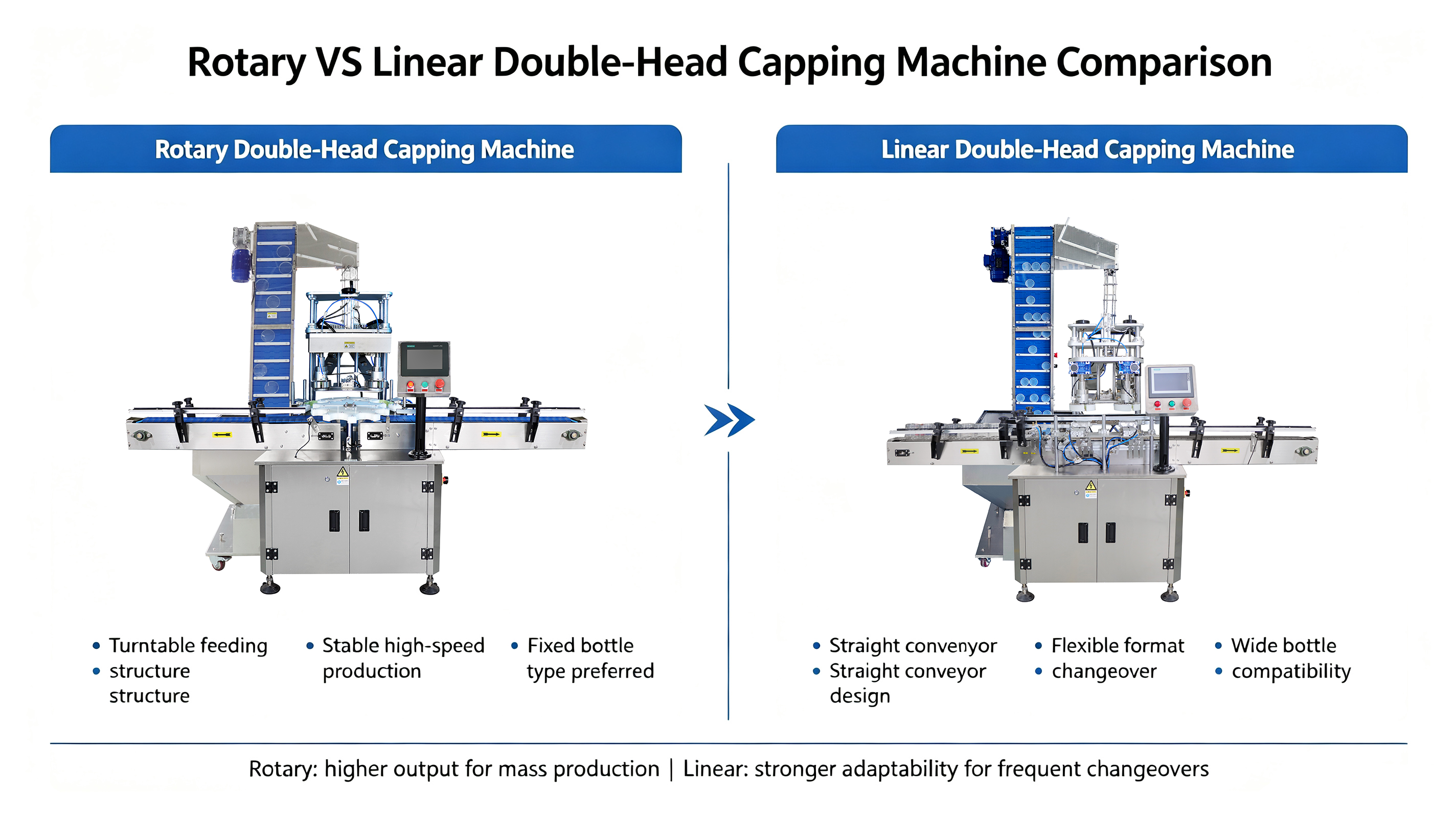
Among the most common solutions are linear capping machines and rotary capping machines. Although both are designed to automatically apply and tighten caps, their machine structures, operating principles, production capabilities, and application scenarios are different.
So, which is better: a linear capping machine or a rotary capping machine?
The answer depends on your bottle type, cap design, required production speed, available space, and packaging line configuration.
What Is a Linear Capping Machine?
A linear capping machine moves bottles through the machine in a straight line while automatically feeding, placing, and tightening caps.
Its straight-line design provides flexible adjustment for different bottle sizes, cap specifications, and production requirements. It is widely used in food, beverage, pharmaceutical, cosmetic, and chemical packaging lines.
What Is a Rotary Capping Machine?
A rotary capping machine adopts a rotating turret to transfer bottles through multiple capping stations, where cap picking and placement, torque tightening are carried out sequentially.
Equipped with double capping heads, this rotary‑type grab‑and‑twist capping machine delivers outstanding performance for high‑speed, large‑volume mass production scenarios..
Linear vs. Rotary Capping Machine: Key Differences
Feature | Linear Capping Machine | Rotary Capping Machine |
Machine layout | Straight-line | Rotary |
Capping head options | Single‑head / double‑head | Double‑head standard |
Bottle size adjustment | Flexible | Depends on configuration |
Production line integration | Easy | Suitable for high-speed lines |
Space requirement | Longer layout | More compact footprint |
Best suited for | Flexible production | High-volume production |
Typical application scenarios | Small‑medium batches | Medium‑high volume |
Suitable container | PET bottle, glass bottle, plastic jars | PET bottle, glass bottle, plastic jars |
The main difference is how bottles are handled and how the capping process is organized. Linear systems focus more on flexibility, while rotary systems are generally designed for continuous high-speed production.
Production Speed and Flexibility
For manufacturers with extremely high production requirements, a rotary capping machine can provide higher throughput through multiple capping stations.
A linear capping machine can also achieve high production speeds, especially with multiple capping heads and an automatic cap feeding system. Its main advantage is greater flexibility when handling different bottle formats.
Choose a Linear Capping Machine When:
- Different bottle sizes or formats need to be handled.
- Frequent product changes are required.
- Flexible adjustment is important.
- The machine needs to integrate easily with filling and labeling equipment.
- Production volume is medium to high.
Choose a Rotary Capping Machine When:
- High-speed continuous production is required.
- Bottle and cap specifications are relatively standardized.
- Production volume is high.
- Multiple capping stations are needed.
- Maximum production efficiency is the priority.
Linear or Rotary: Which One Should You Choose?
For small to medium production, a linear capping machine can provide a good balance between automation, flexibility, and investment.
For medium to high production, both linear and rotary solutions can be suitable. The choice should consider required bottles per minute, bottle specifications, cap type, available space, and future production expansion.
For high-volume production with standardized products, a rotary capping machine is often a suitable choice because multiple capping stations support continuous operation.
Capping Machine Applications
Both linear and rotary capping machines can be used in a wide range of industries, including:
- Food: cooking oil, sauces, seasonings, peanut butter, jam, and pickles
- Beverages: juice, coffee drinks, tea beverages, and water
- Cosmetics: shampoo, lotion, liquid soap, and skincare products
- Chemicals: detergents, cleaning products, adhesives, and industrial liquids
- Pharmaceutical & Nutritional Products: supplements, nutritional products, and pharmaceutical liquids
Your Reliable Source for Complete Capping Machine Solutions
Selecting a capping machine is not only about choosing between linear and rotary technology.
A professional packaging equipment manufacturer should evaluate the complete application, including the bottle, cap, product characteristics, production speed, and upstream and downstream equipment.
As a packaging equipment manufacturer and direct factory, Guangzhou Full Harvest Industries Co., Ltd. provides capping solutions for different bottle and jar packaging applications, including automatic capping machines, linear capping machines, rotary capping machines, servo capping systems, and multi-head capping equipment.
The equipment can be configured according to specific production requirements, helping manufacturers achieve stable cap tightening, consistent torque, efficient production, and reliable integration with complete packaging lines.
Choosing the right capping technology is not simply about choosing the fastest machine—it is about choosing the machine that delivers the right combination of speed, flexibility, stability for your production line.