
Choosing a Filling Machine for Powders, Granules, and Liquids: A Material-Based Selection Guide
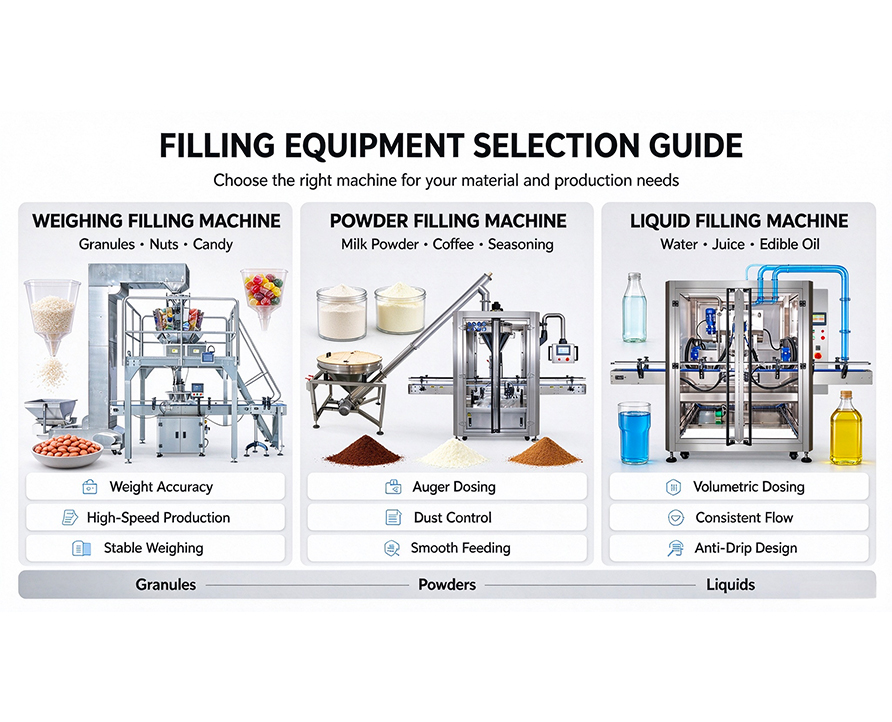
Choosing the right filling machine is a critical step in building an efficient packaging production line. The wrong equipment can lead to inconsistent filling weights, product waste, material blockages, and unnecessary maintenance costs.
However, different materials require different filling methods. Granules need accurate portion control, powders require stable feeding and dust management, liquids demand consistent dosing, and thick sauces may need specialized filling systems to handle their viscosity and solid ingredients.
As a packaging equipment manufacturer, we provide filling solutions ranging from weighing and auger filling machines to piston, magnetic pump, and rotary pump filling machines. This guide explains how to select suitable equipment according to material characteristics, filling requirements, and production needs.
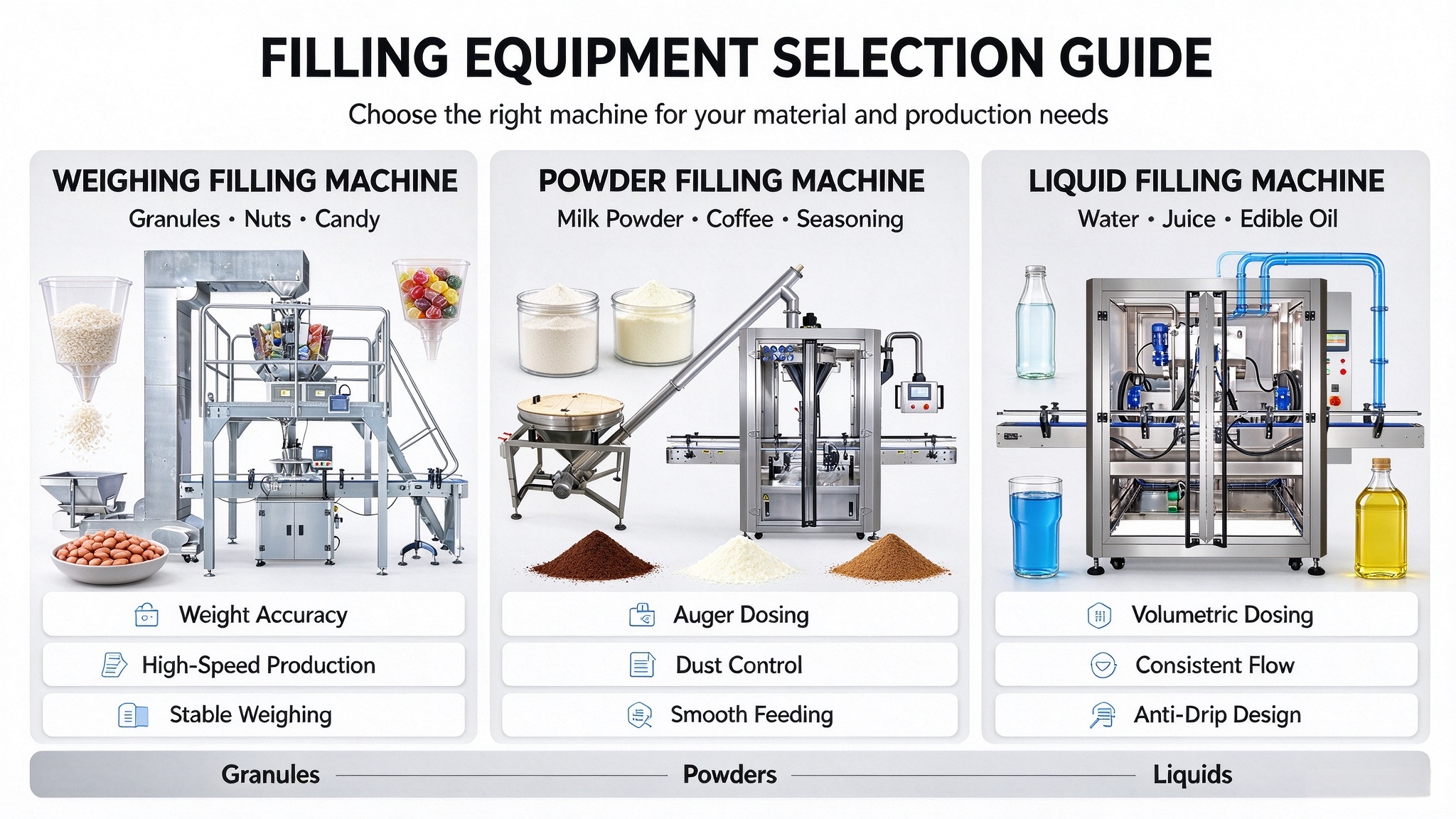
1. Which Filling Machine Is Suitable for Your Material?
Before selecting equipment, consider the material's flowability, particle size, viscosity, and required filling accuracy. These characteristics determine how the product should be measured, transferred, and dispensed.
| Material Type | Typical Products | Recommended Filling Machine | Main Selection Priority |
| Granules | Peanuts, rice, seeds, candy, salt, dried vegetables | Multihead weigher, linear weigher, volumetric cup filler | Weight consistency and production speed |
| Powders | Milk powder, camel milk powder, coffee powder, protein powder, seasoning powder | Auger filling machine | Feeding stability, dust control, and dosing accuracy |
| Free-flowing liquids | Water, juice, edible oil | Magnetic pump filler, piston filling machine | Metering accuracy and liquid compatibility |
| Smooth sauces | Tomato sauce, cooking sauces, syrup | Piston filling machine | Viscosity and consistent dispensing |
| Thick or particle-rich sauces | Chili sauce, peanut butter, fruit paste, chunky sauces | Piston filler or rotary pump filler | Product viscosity, particle size, and product integrity |
2. Granule Filling Machines: Multihead Weigher, Linear Weigher, or Volumetric Cup Filler?
Granular materials vary in shape, size, density, and flowability. For example, peanuts, rice, candy, and dried vegetables may require different feeding and measuring settings even when they use the same general filling technology.
Three common options are multihead weighers, linear weighers, and volumetric cup fillers.
Multihead Weigher
A multihead weigher uses multiple weighing units to calculate suitable combinations of product portions and achieve a target weight. It is commonly used in high-speed packaging applications where accurate portion weighing and production efficiency are important.
Typical products include nuts, candy, dried fruit, and other granular foods.
Best for: High-output production lines requiring flexible target weights and efficient weighing.
Linear Weigher
A linear weigher measures product through a linear weighing arrangement. It offers a practical solution for small- to medium-scale production where a straightforward weighing system can meet the required output and accuracy.
Best for: Granular products such as rice, seeds, beans, and other compatible materials when production speed requirements are moderate.
Volumetric Cup Filler
A volumetric cup filler measures product by volume rather than directly weighing every portion. It is generally economical and straightforward to operate, but the actual filling weight depends on the material's bulk density and how the granules settle inside the measuring cup.
Best for: Applications where product density is relatively stable and the required weight tolerance can be achieved.
3. Powder Filling Machines: Why Choose an Auger Filler?
Powders can be difficult to handle because their flowability varies considerably. Some powders flow freely, while others generate dust, absorb moisture, or form lumps during feeding.
An auger filling machine uses a rotating screw to convey and dispense a controlled quantity of powder into a container or package. It is widely considered for milk powder, camel milk powder, coffee powder, protein powder, and seasoning powder.
The screw-based dosing method allows the filling process to be adjusted according to the product and target quantity. With a suitable feeding structure, it can also help reduce powder scattering.
When choosing an auger filler, consider the following factors:
- Powder flowability: Poor-flowing powders may require an appropriate hopper or feeding arrangement.
- Dust generation: Enclosed feeding structures and suitable dust-control measures may be needed.
- Moisture sensitivity: Hygroscopic powders require suitable environmental and equipment considerations.
- Filling accuracy: Screw design, bulk density, and dosing settings influence the actual result.
- Cleaning requirements: Product-contact components should be accessible for cleaning and product changeovers.
For manufacturers handling several powder products, it is important to evaluate whether the same machine configuration can accommodate their differences in density, flowability, and filling weight.
4. Liquid Filling Machines: Magnetic Pump vs. Piston Filling
Liquid filling equipment is selected according to viscosity, required dosing accuracy, production speed, and product compatibility. Magnetic pump fillers and piston filling machines are two common choices, but they operate differently.
Magnetic Pump Filling Machine
A magnetic pump filler is suitable for many clean, free-flowing liquids, including compatible beverages and edible oils.
Its magnetic drive transfers torque without a conventional rotating shaft seal between the drive and the pumped liquid. This design can reduce leakage risks associated with conventional shaft seals and support controlled liquid transfer.
However, magnetic pump fillers are generally unsuitable for liquids containing hard particles that may damage or obstruct the pump. The product's chemical compatibility with the pump materials must also be checked.
Piston Filling Machine
A piston filling machine draws a measured quantity of product into a cylinder and then dispenses it through a filling nozzle.
It can handle many free-flowing liquids as well as viscous sauces, depending on the piston assembly, valves, and nozzle configuration. This makes it a versatile option for manufacturers filling different liquid products.
For very low-viscosity liquids, suitable nozzles and anti-drip measures may be necessary. For thicker products, the feeding arrangement and product passages must allow the material to move smoothly.
| Comparison Factor | Magnetic Pump Filling | Piston Filling |
| Typical applications | Compatible, free-flowing liquids | Liquids and many viscous products |
| Metering method | Pump-based dosing | Piston-based volumetric dosing |
| Main advantage | Smooth liquid transfer and reduced shaft-seal leakage risk | Broad application range |
| Particle handling | Generally unsuitable for hard particles | Depends on valve and nozzle design |
| Main consideration | Pump compatibility and liquid properties | Viscosity, filling volume, and product passages |
How to choose: For relatively clean liquids such as water and edible oil, a magnetic pump filler may be appropriate. If the product has a wider viscosity range or requires piston-based volumetric dosing, consider a piston filling machine.
5. Sauce Filling Machines: Piston Filler vs. Rotary Pump Filler
Sauces and pastes can be more challenging to fill because of their high viscosity, sticky texture, or solid ingredients. Chili sauce, tomato paste, peanut butter, fruit paste, and chunky sauces may require different filling configurations.
Piston Filling Machine for Smooth Sauces
A piston filler is a strong option for many smooth sauces and pastes when controlled volumetric dosing is important.
It can handle a broad range of viscosities with suitable product-contact components and nozzle designs. For thick sauces, the machine may require larger product passages or a suitable feeding system to maintain stable filling.
However, products containing large solid pieces can be difficult to handle if the valves or nozzles restrict product flow.
Rotary Pump Filling Machine for Particle-Rich Sauces
A rotary pump filler is worth evaluating when sauces contain visible fruit or vegetable pieces that should retain their shape.
Its pumping action can support relatively gentle product transfer when the pump is correctly selected and operated. Suitability depends on particle dimensions, viscosity, rotational speed, pump geometry, and the product's sensitivity to shear.
| Comparison Factor | Piston Filler Machine | Rotary Pump Filler Machine |
| Typical products | Smooth sauces, pastes, thick liquids | Chunky sauces, fruit preparations, particle-rich products |
| Main advantage | Controlled volumetric dosing | Suitable for compatible particle-containing materials |
| Particle handling | Depends on valves and nozzle passages | Depends on rotor geometry and product passages |
| Main consideration | Dosing stability and nozzle design | Particle integrity, flow rate, and pump configuration |
6. Five Factors to Consider Before Purchasing a Filling Machine
| Selection Factor | Key Questions |
| Material characteristics | Is the product a powder, granule, liquid, or paste? Does it flow freely? |
| Particle size and viscosity | Does it contain solid pieces? Is it thin, thick, or prone to clogging? |
| Filling accuracy | What target weight or volume and tolerance are required? |
| Production capacity | How many containers or packages must be filled per minute? |
| Container and line configuration | Are you filling bottles, jars, cans, or pouches? Does the machine need to connect to downstream equipment? |
7. Integrating the Filling Machine into a Complete Packaging Line
Filling is often only one stage of a complete packaging process. Depending on the container and product, the filling machine may need to connect to capping, can sealing, labeling, and other packaging equipment.
For example:
- Granule packaging: A multihead weigher can be integrated with a compatible filling and sealing system.
- Powder packaging: An auger filler can be configured for the intended container or package, with suitable downstream closing equipment.
- Liquid packaging: A magnetic pump or piston filler can be connected to a capping machine and labeling machine.
- Sauce packaging: A piston filler or rotary pump filler can be integrated with a suitable capping or can sealing system.
As a packaging equipment manufacturer, we provide filling equipment and solutions that can be configured for different materials, containers, and production workflows. Selecting compatible machines at the planning stage helps improve line coordination and reduce avoidable production bottlenecks.
Frequently Asked Questions
Q1. Which filling machine is best for granules?
A multihead weigher is suitable for many high-speed, weight-controlled applications. Linear weighers and volumetric cup fillers may be suitable for simpler production requirements.
Q2. Which machine is commonly used for powder filling?
An auger filling machine is widely used for milk powder, coffee powder, protein powder, and seasoning powder because it provides controlled screw-based dosing.
Q3. Can one filling machine handle both liquids and sauces?
A piston filling machine can handle many liquids and sauces, but extremely thin liquids, very thick pastes, and products containing large particles may require different configurations.
Q4. Which filling machine is suitable for chunky sauces?
A rotary pump filler may be appropriate for compatible particle-rich sauces. The final selection should be confirmed by testing the actual product.
Q5. What information is needed to recommend a filling machine?
The most useful information includes product type, viscosity or particle size, target filling weight or volume, container dimensions, and required production speed.
Conclusion
Choosing the right filling machine starts with understanding the material and the production requirements.
Multihead weighers and linear weighers are common solutions for granules, auger fillers are widely used for powders, magnetic pump and piston fillers serve different liquid applications, and rotary pump fillers can be considered for suitable thick or particle-rich sauces.
As a packaging equipment manufacturer, we provide filling solutions that can be integrated with capping machines, can sealing machines, labeling equipment, and complete packaging lines.
Contact us with your product details, target filling quantity, container type, and required output to discuss a suitable filling solution for your production needs.