
Automatic Four-Wheel Capping Machine: Working Principle, Features and Applications
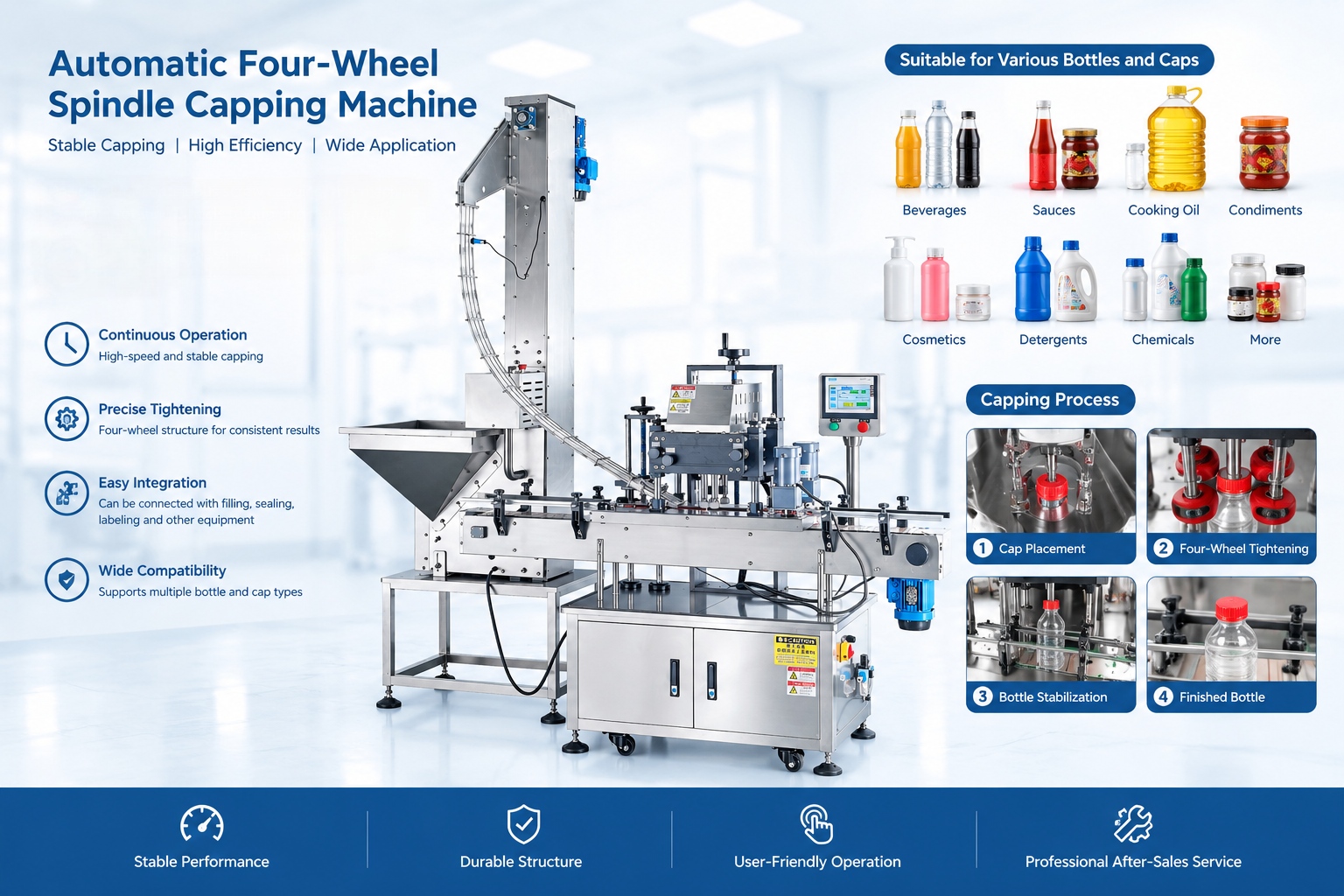
For automatic bottle packaging, capping is an important step between filling and final packaging. A suitable capping system needs to handle the cap consistently while matching the bottle, production speed and requirements of the complete packaging line.
An automatic four-wheel capping machine is designed for continuous screw capping. It uses four rotating wheels to grip and tighten compatible screw caps while bottles move along the conveyor.
But how does this type of machine work, and when is a four-wheel spindle capping machine a suitable choice?
What Is an Automatic Four-Wheel Capping Machine?
An automatic four-wheel capping machine is a continuous bottle capping machine designed to automatically tighten screw caps on compatible bottles.
The main capping section uses four rotating wheels. After a cap is placed on the bottle neck, the bottle passes through the capping wheels. The wheels contact the cap and rotate it progressively until the cap is properly tightened.
Unlike an intermittent manual capping process, bottles can continuously move through the capping section.
The basic process can be summarized as:
Bottle Feeding → Cap Placement → Cap Alignment → Four-Wheel Tightening → Finished Bottle Discharge
This makes the machine suitable for automatic packaging lines where stable and continuous screw capping is required.
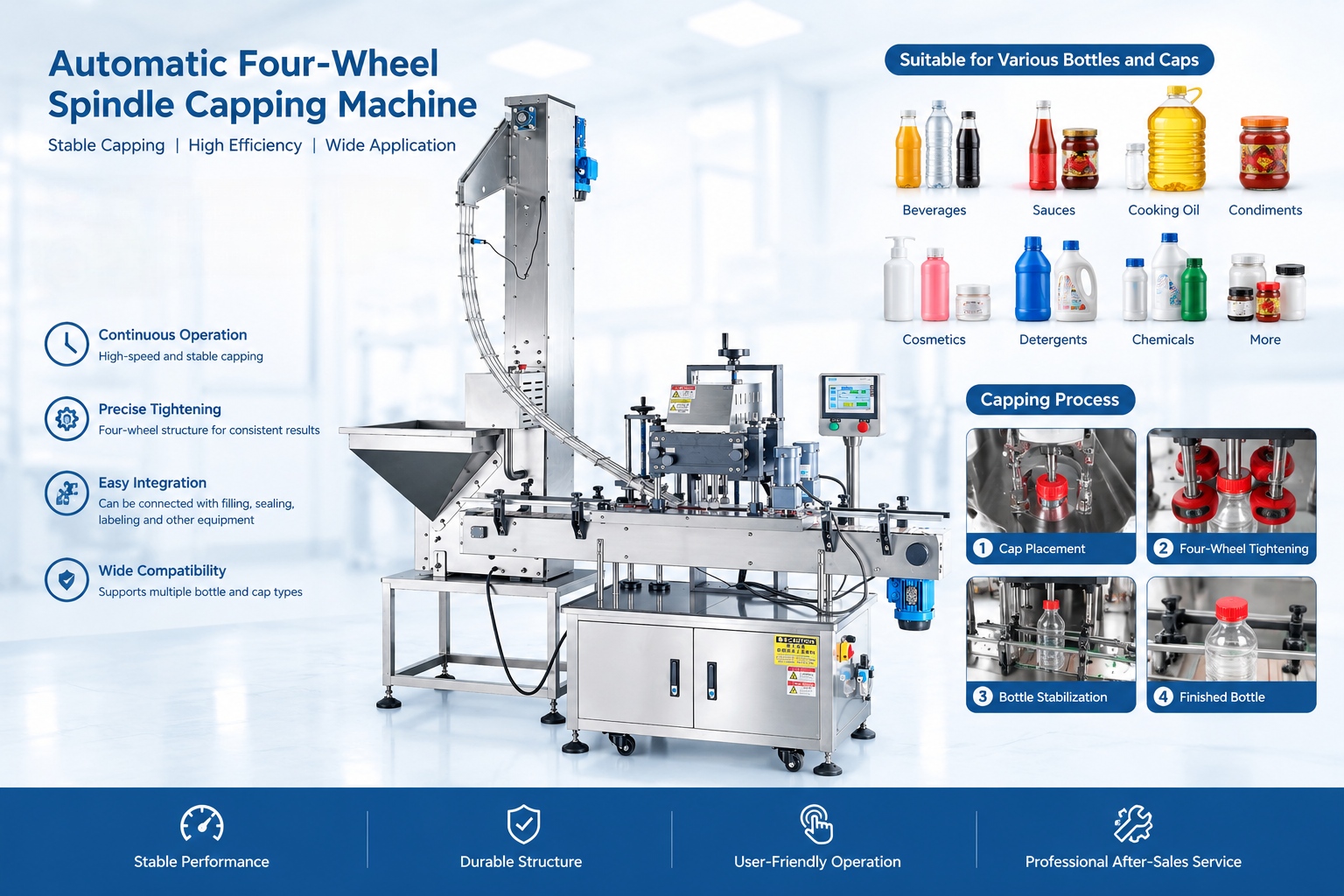
How Does a Four-Wheel Capping Machine Work?
The capping process can be divided into several stages.
1. Bottle Feeding
Filled bottles enter the capping machine through the conveyor system. The bottles are guided into the correct position before entering the capping section.
2. Cap Placement
The cap is supplied and placed onto the bottle neck. Correct cap positioning is important because the cap needs to engage properly with the bottle thread.
3. Bottle Stabilization
The bottle is guided and stabilized while passing through the capping wheels. This helps maintain consistent contact between the cap and the rotating wheels.
4. Four-Wheel Tightening
The four rotating wheels contact the sides of the cap and progressively rotate it.
As the bottle moves forward, the cap is tightened onto the bottle neck.
5. Finished Bottle Output
After capping, the finished bottle continues along the conveyor to the next packaging process.
For example:
Four-Wheel Capping → Induction Foil Sealing → Labeling → Inspection → Collection
The actual line configuration can be customized according to the product and production requirements.
Why Use Four-Wheel Capping Machine?
The four-wheel design is intended to provide stable cap handling during continuous automatic production.
Continuous Capping
Bottles can move continuously through the capping section instead of requiring an operator to tighten each cap individually.
Consistent Cap Handling
The multiple rotating wheels provide continuous contact with the cap during tightening, helping maintain a repeatable capping process.
Suitable for Automatic Production Lines
The machine can be connected with upstream and downstream equipment, making it suitable for complete automatic packaging systems.
Flexible Packaging Applications
With the correct machine configuration, four-wheel spindle capping can be considered for different products packed in compatible screw-cap bottles.
Reduced Manual Operation
Automatic bottle transportation and cap tightening can reduce the amount of manual intervention required during production.
Four-Wheel Capping Machinevs. Other Automatic Capping Machine Solutions
A four-wheel capping machine is not the only solution for automatic screw capping.
Depending on the bottle, cap and production requirements, manufacturers may also consider an eight-wheel capping machine or a Screw Capping Machine.
| Machine | Four-Wheel Capping Machine | Eight-Wheel Capping Machine | Single Head Screw Capping Machine |
| Capping speed | 20–30 bottles/min | 80–100 bottles/min | 15–25 bottles/min |
| Cap diameter | 35–130 mm | 80–100 mm (customized) | 25–130 mm |
| Bottle diameter | 35–130 mm | 80–130 mm (customized) | 30–125 mm |
| Bottle height | 25–220 mm | 100–250 mm (customized) | 30–220 mm |
| Power | 1000 W | 1500 W | 1000 W |
| Power supply | Single-phase AC220V 50/60 Hz | AC220V 50/60 Hz | AC220V 50/60 Hz |
| Capping mode | Continuous | Continuous | Automatic screw capping |
| Production-line integration | Suitable | Suitable | Suitable |
| Typical selection focus | Bottle, cap and production requirements | Bottle, cap and higher wheel-contact requirements | Cap design and required tightening condition |
Four Wheels or Eight Wheels: Which One Should You Choose?
The number of wheels should not be the only factor considered when selecting a capping machine.
An eight-wheel machine provides more wheel contact points, while a four-wheel machine uses a simpler wheel configuration.
A four-wheel capping machine may be considered when:
- The bottle and cap combination is suitable for four-wheel capping.
- Continuous automatic production is required.
- Stable cap tightening can be achieved with four wheels.
- The production line does not require an eight-wheel configuration.
- The machine needs to remain practical for integration with other packaging equipment.
An eight-wheel configuration may be evaluated when the specific bottle and cap application requires additional wheel contact during the capping process.
The final choice should be confirmed through actual bottle and cap testing.
Applications of Automatic Four-Wheel Capping Machines
Four-wheel spindle capping can be used for a wide range of products packaged in compatible screw-cap containers.
Food and Beverage
Typical applications may include:
- Juice
- Beverages
- Cooking oil
- Sauces
- Condiments
- Liquid food products
Cosmetics and Personal Care
Applications can include:
- Shampoo
- Body wash
- Liquid soap
- Cosmetic liquids
- Personal care products
Household and Chemical Products
Compatible applications may include:
- Detergents
- Cleaning liquids
- Household chemicals
- Other liquid products
The actual application depends on the bottle and cap rather than the product category alone.
What Should You Check Before Buying a Four-Wheel Capping Machine?
Before selecting an automatic capping machine, several points should be confirmed.
1. Bottle Dimensions
Confirm the bottle diameter, height, neck position and shape.
2. Cap Specifications
Check the cap diameter, height, thread and material.
3. Required Production Capacity
The capping speed should match the filling machine and the rest of the production line.
4. Capping Performance
Determine how tightly the cap needs to be closed and whether the application has specific closure requirements.
5. Product Characteristics
Product viscosity, filling level and possible splashing can influence the capping process.
6. Complete Line Compatibility
If the machine will be installed in an automatic packaging line, it should match the conveyor and output requirements of the other machines.
FAQ
What is a four-wheel capping machine?
A four-wheel capping machine is an automatic capping machine that uses four rotating wheels to tighten compatible screw caps on bottles during continuous production.
What is the difference between a four-wheel and an eight-wheel capping machine?
The main difference is the number of rotating capping wheels and the resulting machine configuration. The appropriate choice depends on the bottle, cap and required capping performance.
Is a four-wheel capping machine suitable for plastic bottles?
It can be suitable for compatible plastic bottles with screw-type caps. Bottle dimensions, neck design, cap specifications and capping requirements should be tested before selection.
What is a Screw Capping Machine?
A Screw Capping Machine uses a capping head to grip and rotate the cap onto the bottle. It is another automatic solution for compatible screw-cap applications.
Can a four-wheel capping machine be connected to a filling machine?
Yes. It can be integrated with filling machines, induction foil sealers, labeling machines and other packaging equipment to form a complete automatic production line.
How should I choose a four-wheel capping machine?
Start with the bottle and cap specifications, then consider the required production speed, tightening requirements and compatibility with the complete packaging line. Testing the actual bottle and cap is recommended before final selection.