
A Practical Guide to Choosing Filling Machines for Liquids, Sauces, and Pastes
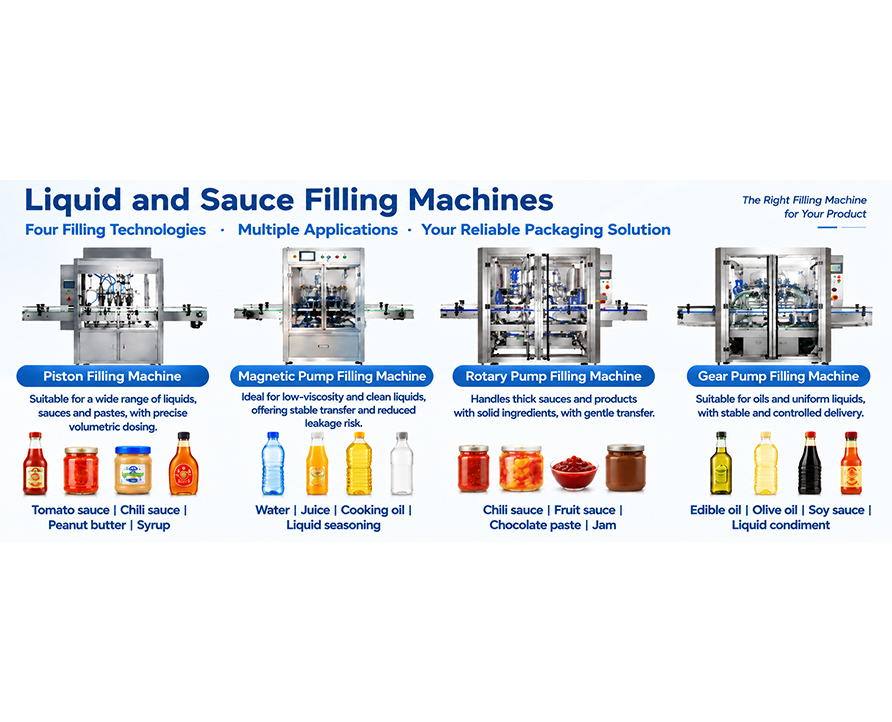
Selecting the wrong filling machine often shows up later as inconsistent volumes, product waste, dripping, or slow cleaning—not at the quotation stage. Water, juice, cooking oil, tomato sauce, chili sauce, and fruit pastes each behave differently in a filling system, and the same equipment that works well for one product may underperform on another.
This guide compares four filling technologies—piston fillers, magnetic pump fillers, gear pump fillers, and rotary pump fillers—across product compatibility, dosing accuracy, and application range. Guangzhou Full Harvest Industries Co., Ltd has organized the comparison around the factors that most often determine whether a filling line runs smoothly: product characteristics, filling volume, container design, and production capacity.
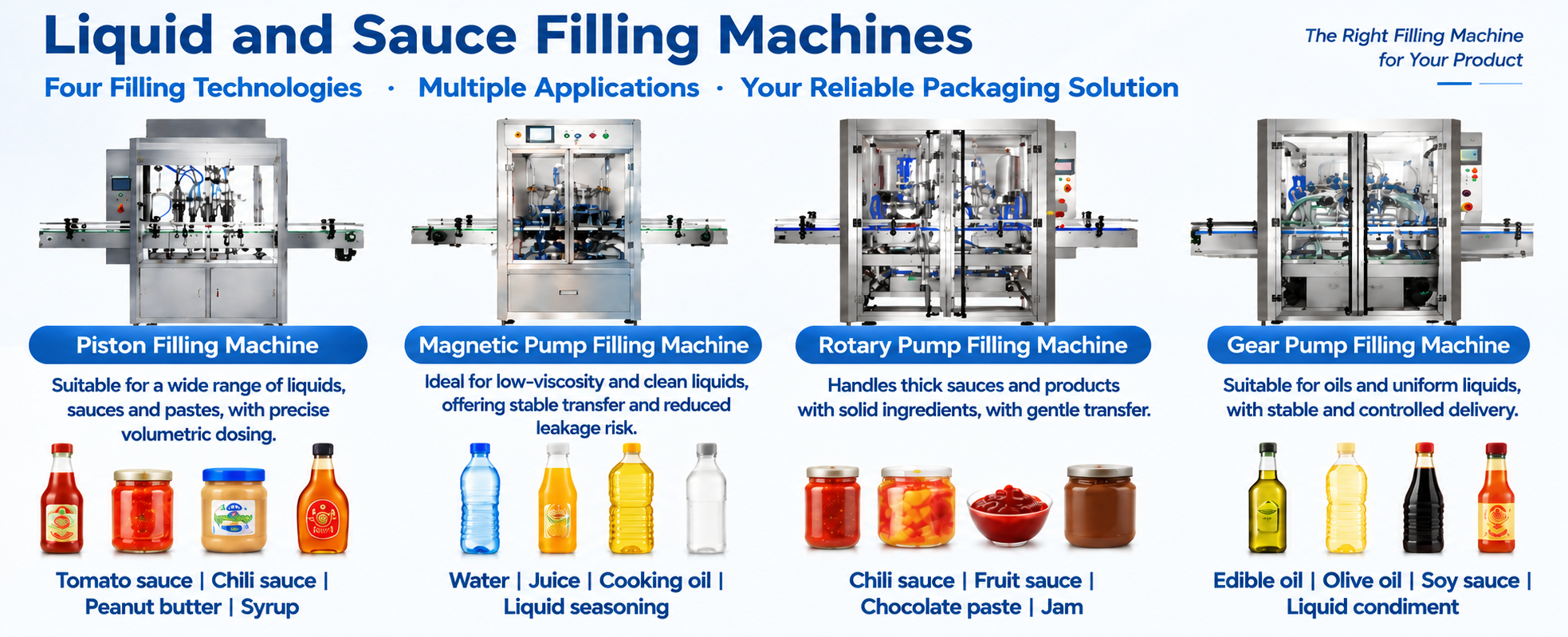
1. Which Filling Machine Is Suitable for Your Product?
Different products require different dosing methods. The following table provides a quick overview of common applications.
| Product Type | Typical Products | Recommended Filling Machine |
|---|---|---|
| Low-viscosity liquids | Water, juice, sugar water | Magnetic pump filler, piston filler |
| Cooking oils and liquid seasonings | Edible oil, liquid condiments | Magnetic pump filler or gear pump filler |
| Smooth sauces | Tomato sauce, cooking sauce | Piston filler or pump filler |
| Thick pastes | Chili sauce, bean paste, peanut butter, chocolate paste, loquat paste | Horizontal piston filler or compatible pump system |
| Sauces containing solid pieces | Chunky chili sauce, fruit preparations | Rotary pump filler |
2. Piston Filling Machines: Horizontal vs. Vertical
A piston filling machine uses a piston and cylinder to draw in and dispense a measured quantity of product. It is widely used for liquids, sauces, and pastes.
Horizontal and vertical piston fillers are common configurations, with different arrangements suited to different product-handling requirements.
| Comparison | Horizontal Piston Filler | Vertical Piston Filler |
|---|---|---|
| Typical applications | Thick sauces and pastes | Free-flowing liquids and sauces |
| Example products | Tomato sauce, thick chili sauce | Juice, liquid seasonings, smoother sauces |
| Main consideration | Feeding and discharging viscous materials | Product flow and filling-head configuration |
The suitability of either configuration depends on the piston assembly, product feeding method, and filling-head design.
For highly viscous products, a horizontal piston filler can be configured with a suitable product-contact tube connected directly to the filling head. This arrangement can support the transfer of thick materials, although the filling head may not support diving or bottom-up filling.
A vertical piston filler is worth considering when the product flows more easily and the filling process suits a conventional vertical arrangement.
What if the filling volume ranges from 1 L to 5 L?
When a machine needs to accommodate a wide filling-volume range, a pump-based system may be worth evaluating.
The pump's flow range, control method, product characteristics, and required filling tolerance should all be considered. A piston filler may also be suitable if its dosing range and configuration meet the application requirements.
3. Pump Filling Machines for Liquids and Sauces
Magnetic pumps, gear pumps, and rotary pumps use different mechanisms to transfer products. Their suitability depends on the liquid's properties and the pump's design.
3.1 Magnetic Pump Filling Machine
Magnetic pump fillers are commonly used for compatible, relatively clean liquids that require controlled transfer.
A magnetic pump uses magnetic coupling to transmit torque from the motor to the pump mechanism. In typical designs, this arrangement eliminates the conventional rotating shaft seal between the drive and the pumped liquid, reducing leakage risks associated with that seal.
Different pump configurations can accommodate different filling volumes and production requirements.
Small round magnetic pump: Suitable for small filling quantities, such as applications below 200 mL, including liquid addition after granules have been filled into containers.
Large round magnetic pump: Worth considering for applications requiring larger filling quantities or higher production output.
Square magnetic pump: An alternative configuration for applications requiring relatively high filling speed and larger filling quantities.
Corrosion-resistant magnetic pump: Suitable for compatible corrosive liquids when the wetted materials are selected according to the product's chemical properties.
The appropriate pump should be selected according to liquid compatibility, viscosity, filling quantity, and required output.
Magnetic pumps are generally not the first choice for products containing hard particles. Excessive viscosity can also affect pump performance and increase the demands on the drive system.
Best suited for: Compatible, relatively clean liquids where controlled transfer and reduced shaft-seal leakage risk are priorities.
3.2 Gear Pump Filling Machine
Gear pump fillers use rotating gears to transfer liquid through a pump chamber. They are often considered for edible oils, olive oil, liquid seasonings, and other compatible, relatively uniform liquids.
As the gears rotate, liquid enters the pump inlet, moves through the spaces between the gear teeth and housing, and exits through the outlet.
Gear pumps can provide controlled liquid transfer when correctly selected and configured. However, their internal clearances make them sensitive to hard or abrasive particles, which may cause wear or interfere with operation.
Very viscous products may also require additional driving torque and an appropriate feeding arrangement.
Best suited for: Compatible oils and uniform liquids where gear-based pumping meets the required dosing and production requirements.
3.3 Rotary Pump Filling Machine
Rotary pump fillers can be considered for selected thick sauces, pastes, and products containing solid ingredients. The rotor design influences product flow, particle clearance, and the potential to preserve the shape of solid pieces.
Different rotor configurations may be suitable for different particle sizes.
| Rotary Pump Type | Potential Applications | Indicative Particle Size |
|---|---|---|
| Straight or bar-shaped rotor | Thick sauces containing relatively large fruit or vegetable pieces | Approximately 10–15 mm |
| Two-lobe rotor | Viscous sauces containing smaller solid pieces | Generally below 10 mm |
| Three-lobe rotor | Pastes and liquids containing very small, soft particles | Generally below 1 mm |
For sauces containing visible fruit or vegetable pieces, the pump should be selected to accommodate the largest particles while meeting the required product-integrity and filling-performance requirements.
Rotary pump filling accuracy also depends on the pump design, control method, and material characteristics.
Best suited for: Compatible thick sauces and particle-containing products when the selected pump can handle the actual material.
4. How to Select the Right Liquid and Sauce Filling Machine
Use the following process to narrow down the available options.
Step 1: Identify the product characteristics.
Determine whether the product is a free-flowing liquid, a smooth sauce, a thick paste, or a sauce containing solid ingredients.
Step 2: Select a suitable filling technology.
Water, juice, and other compatible low-viscosity liquids: evaluate magnetic pump or piston filling.
Edible oils and relatively uniform liquid products: evaluate magnetic pump or gear pump filling.
Smooth, thick sauces: start by evaluating a suitable piston filler.
Sauces containing fruit or vegetable pieces: consider a rotary pump or another particle-compatible filling system.
Step 3: Confirm the filling requirements.
Define the target filling quantity, acceptable tolerance, production speed, and required number of filling heads.
Step 4: Check container compatibility.
Bottle, jar, and can dimensions affect filling-head positioning, nozzle size, and equipment layout.
Step 5: Evaluate the complete packaging process.
Consider cleaning requirements, product changeovers, maintenance access, and integration with downstream equipment.
A filling machine can be integrated with a capping machine or can sealing machine, followed by labeling and other packaging equipment. Planning these stages together helps improve line coordination and avoid unnecessary production bottlenecks.
Frequently Asked Questions
Q1. Which filling machine is suitable for thick chili sauce?
A horizontal piston filler is a common option for smooth, thick chili sauce. If the sauce contains large solid pieces, evaluate a rotary pump or another filling system designed for the actual particle size.
Q2. Which pump is suitable for sauce containing fruit pieces?
The choice depends on particle dimensions, product viscosity, and the need to preserve particle integrity. A suitable rotary pump may be considered, but the final configuration should be confirmed through product testing.
Q3. Which filling machine is suitable for filling volumes from 1 L to 5 L?
A pump-based system may offer a suitable solution, depending on its flow range and control method. A piston filler may also work if its dosing range and required accuracy meet the application requirements.
Q4. Can one filling machine handle both liquids and sauces?
Some piston filling machines can handle multiple products with different viscosities when the dosing range, product passages, valves, and nozzles are suitable. Product compatibility and cleaning requirements should be evaluated before using one configuration for several materials.
Q5. How can I confirm the filling accuracy before purchasing?
Provide the actual product, target filling quantity, container dimensions, and required tolerance. A filling test under representative operating conditions can help verify the machine's suitability.
Conclusion
Choosing the right liquid and sauce filling machine starts with understanding the material and the production requirements.
Magnetic pump fillers are worth evaluating for compatible, relatively clean liquids. Gear pump fillers can provide controlled transfer for suitable oils and uniform products. Piston fillers offer a versatile solution for many liquids and smooth sauces, while rotary pump fillers can be considered for selected thick sauces and particle-containing products.
Guangzhou Full Harvest Industries Co., Ltd provides filling solutions for different liquids, sauces, filling quantities, and container types, with options for integration into capping, can sealing, labeling, and complete packaging lines.